Back in December, a number of students from an area academic high school (liceo) came to visit SYA Italy to get a taste of life in an "American School." I chatted with the Physics teacher who came along and I got his email and we organized a visit to the Italian school. The way the Italian education system works, at least what I think I learned in my conversations, is that up until 8th grade, all students are in local elementary and middle schools. During the 8th grade year they take an exam to simply make sure they have mastered the knowledge and material they should as dictated by the government. At that point, students make a decision as to where to finish their education. They can choose a "liceo", which is the academic high school. Their other options are "technical" school and another option, which I wasn't able to truly understand. The liceo's are separated into those that are scientifically focused and those that focus on social sciences or the classics. The school we visited was the scientific liceo in a town called Ronciglione, about a half an hour away from Viterbo. Schools in Italy start at 8AM and there are 5 one hour classes a day with school ending at 130PM so students can get home for lunch. The tradeoff? Classes on Saturday. Students are in the liceo for 5 years and are assigned to a class of about 20-25 with whom they will remain for the entire five years. The class is assigned a room in which they take all their classes for all five years. The students don't move, the teachers do. It was a fun visit, there are lots of differences in the way things are taught, BUT high school students are the same everywhere. Even though I didn't understand the jokes and barbs the Italian students were tossing back and forth, I could totally comprehend the tone and humor that was present. Teenagers are FUNNY in any language!
Liceo "A. Meucci" in Ronciglione
This liceo occupies three different buildings. There are six sections of each of the five classes. 14 sections are in this building, with a middle school on the top floor. 10 sections are in a building nearby and the other 6 a few blocks away.
The school principal, in the red vest, with some of the teachers and the seven students who joined me in the visit. Here we are being fed (it's Italy of course there is food) before class visits.
Before class, I was taken out for coffee by a couple teachers. Shown here are a physics, math and art teacher. Can you guess which is the art teacher?
An empty hallway minutes before the students pour out for break.
My first class visit was to a section of math for 5th year students. Lots of thanks to section 5B, they were fun to watch and interact with. You'll notice that there is only blackboard and chalk. Not much technology in the classroom here in Italy.
Kylie K. and Zoe M. in class with their Italian counterparts. By the way, the writing on the red sweatshirt in the back was "Horny Devil" but as per usual he had no idea what it meant. The girls did their best to explain its meaning.
The students are essentially in a calculus course, but the problem that they started with was to find the point of intersection of the function shown. In private high schools in the US, we would simply plug this into our TI's and use the intersection tool. But here, the students found that there was a change in sign and then honed in on the answer. I learned that Italian students learn the same material (duh, of course) but they spend MUCH MORE TIME on repetition and computation. In my classroom, I ask questions that are more conceptual and ask students to integrate their knowledge whereas students here have to do much more computation.
Maybe because the students are I were in the classroom this morning, the students were really animated. They especially wanted to laugh at the fact their English was better than their teacher's. My student's make fun of my Italian in the same fashion. Here, a couple of the boys got up to explain the problem to their peers.
Professor Argenti on the right then asked me to present the students a problem. I asked the students if they liked this teacher because I could tell that he is the kind of teachers connect with. They confirmed my hunch.
And so I do my thing and it becomes a math teacher problem challenge session.
One of the American students up at the board. The heat is on!
By the end of class, the students in back were bunched up in front. Here, as in all of Italy, the boys have no problems being totally physical with each other in a platonic way. It's totally great because they are always jumping on each other and pushing each other around. It's fun and funny to watch.
The second class I visited was a 3rd year Physics class. Here is Professor Bracciani, the one with whom I organized the visit, confiscating a passed note and reading it aloud. Ahh, teachers everywhere united in battling the passing of the notes!
Saturday, January 30, 2010
Sunday, January 24, 2010
Juventus -- Roma
First of all, in Italia, the home team is listed first so I traveled to Torino, home of Juventus of Torino, which seems to be beloved by many, especially director's assistant and former HRS student Adam Z. Adam and I were Facebook chatting a few weeks ago and lo and behold, my team (well kind of since their the closest and I'm still deciding whether to adopt them as MY team), Roma was playing his team this past Saturday. Deciding to seize the moment, I got us tickets and a date was made. I fly up to Milano, near where he lives, and we took the train over to Torino. I spent 9 hours on the train getting back to Viterbo. I made some friends with Genoa supporters as they were on the train to their game. Calcio, or soccer, is a universal language.
Juventus plays its home games at Stadio Olympico Torino, which now is the 4th Olympic stadium I've visited while here on my European stint.
Here is Adam Z. sporting his Juventus gear. I bought tickets that were one level up from bleachers and as you can see we were right down near the action. Actually, row 2. The only issue was that we couldn't see into one corner, but who cared?
Adam was excited to get to sing the Juventus fan song which he had been practicing for years.
#10 Totti is the star of the Roma team and has been for a decade.

Yeah, row 2!
Portiere=Goalie and on the left we have Buffon, Juventus' goalie and national team goalie. Allenetore=Coach and in the black jacket Ciro Ferrara. Ferrara is on the hot seat in his first year as team coach. His face is in the paper every single day.
Roma scored in the final minutes of extra time. Looks like Ferrara is headed for the chopping block.

Thursday, January 21, 2010
Here's the proof I've been waiting for my entire life.
From Science magazine, Is Rice Domestication to Blame for Red-Faced Asians? FINALLY!!
Tuesday, January 19, 2010
January 1944
We all know about the Facists of Italy in WWII. The right-wing government of Mussolini was allied with the Germans to form the first "Axis of Evil." Those who are up on the WWII history know that in 1943, the Italians switched sides and abandoned the Axis and joined the Allies. However, the issue became the German military, formerly welcomed into the country, now being enemy occupants of Italy. In an effort to oust and defeat the Germans, the Allied forces (read American Air Force) bombed cities and towns up and down the Italian peninsula. One of those was Viterbo and it was bombed in 1944 because the Germans had an artillery depot here. A memorial/commemoration of that event is ongoing here town. There are pictures of bombed locations that I walk by everyday. I've included those photos as well as ones of those locations as they look today.
Monday, January 18, 2010
Paying Back my Good Karma
Long time readers of the blog will know I have had TWO great stories of my losing something of value to have it come back to my due to the generosity of others to do the work to get my items back to me. The first was the time when I got my camera back from Panama and the second time was in the summer of 2008 when the kind employees of American Eagle returned my untagged bag to me in Texas.
So what happened this time where I was the good guy? When my hiking group was riding in the van from the desert back to Marrakech, one of the guys I was with found a very expensive photo storage unit/viewer under his seat. Since the settings were in Italian, we deduced that the viewer's owner was an Italian and I would take it with me back to Italy. Meanwhile, my friend John from Norway contacted Epson and confirmed that the viewer was registered to a man in Italy, but due to security issues the name was unable to be released. I then downloaded a few photos and sent them to John who using his magic found an electronic signature which allowed him to find the website of the photographer here in Italy. I then had a friend who speaks Italian call the owner and a match was made. Today, he came up from Rome and picked up his viewer. Case closed. I'm still one in debt karmawise, but I'm at least half way to being even with the world.
Saturday, January 16, 2010
Friday, January 15, 2010
Roman Forum, Colosseum and Palatine Hill
In this second semester, the Art History and Ancient History courses focus studies on the Roman Empire and Renaissance Italy. Therefore, most day Friday day excursions take the school to Rome. There is one Friday trip each in January, February and March. Two of the three are repeated each month and each student must attend the tour of the Vatican and the tour of the Roman Forum. The third trip each month is a "wild card." The first "wild card" was a scavenger hunt to many great historical and visual sites of Rome which I organized. 10 pairs of students scattered around Rome using their BIRG ticket (a 9 Euro all day pass which allows them to ride all subways, trains and buses -- a TRUE bargain). Students on the scavenger hunt were required to find the answers to questions and take pictures of themselves in front of these sites. Think high school students enjoying themselves in Rome and interacting with locals and getting pictures of themselves all over the place....I was rolling on the floor of the train on the way home. They are priceless and I will post the best of in the next week or so.
Because my work was all done as preparation, I got to spend the day on one of the other trips and I chose to join the group visiting the Roman Forum. The legend goes that Rome was founded on the Palatine Hill by the twins Romulus and Remus back in 753 BCE. The flat area at the base of the hill became the Roman Forum, where many public buildings and houses of worship were built over the course of the next 1,000 years, most of them being erected at the time of the height of the Roman Empire, the first first few centuries CE.
The excavations of the Palatine Hill provide evidence that these "bell" shaped huts were the first buildings on the site. The Palatine Hill in time because the most prestigious address in Ancient Rome, the Beverly Hills of Rome as you might say as it appears every leader built some sort of residence on the Palatine Hill.
Just to the north of the Palatine Hill is the flat area which became the Roman Forum. At the western end, at the base of the Capitoline Hill, has stood different incarnations of The Temple of Saturn. What we see here is most likely third Temple of Saturn having been rebuilt after fires.
Just to the north of the Temple of Saturn is the Curia, or the building in which the Roman Senate met.
I know about the Vestal Virgins (VV) from the line in the song "A Whiter Shade of Pale" but what were they. There were six VV who were selected at age 6 from the elite Roman families. For 10 years they trained to carry out the duty of keeping the flame in the temple going. The flame represented the founding of Rome or something of that nature. 10 years of duty and then 10 years of training the next set of VV. The story goes that is a young woman lost her virginity, she was buried alive.
Here is a partial reconstruction (by Mussolini no less) of the temple of the Vestal Virgins.
The great Augustus (adopted son of Julius Caesar) consolidated power and became the first Roman Emperor and he died in 14 CE he was succeeded by a succession of rulers called the Julio-Claudians, the last of which was Nero, who was in a word INSANE. The great Roman fire of 64 CE, which some think Nero set himself, burned a majority of the city. In the wake of the fire, Nero appropriated for himself much of the prime real estate to the east of the Forum and much of the Esquiline Hill to build his grand Domus Aurea, or his Golden House. This house had a kilometer long colonnade and a huge naked statue of himself. Nero could make it this large because of the new material, CONCRETE. Nero committed suicide in 68 CE.
The remains of Nero's Domus Aurea with the Colosseum in background. The land upon which the Colosseum stands was the Domus Aurea's fish pond.
Nero's successor was Vespasian (ruled 69-79 CE), the first of the Flavian emperors. To bring a sense of order back to Rome, he had his portraits made with "verism" showing his age and flaws to try and portray being and elder statesman.
Vespasian, in a brilliant political move took Nero's fish pond and gave it back to the people of Rome in the form of the Colosseum, a public space. Vespasian understood the idea of "Bread and Circus", keep your subjects fed and entertained and they'll be happy.
During Vespasian's rule, his son, Titus, won some major victories, the key being conquering Jerusalem. Titus, unfortunately for the Roman people, lived for only two years after being installed as Emperor in 79 CE. During his two year reign, he had to deal with the eruption of Vesuvius. After his death in 81 CE, the Roman Senate bestowed "god" status to Titus and they erected a triumphal arch to him.
Titus
The Arch of Titus stands at the eastern end of the Roman Forum and required pedestrians to walk under it as they proceeded from the Colosseum into the Forum.
The panel on the south side of the inside of the arch shows victory crowning Titus in his triumphal chariot. Also present are Honor and Valor the first known instance of the mixing of human and divine figures in Roman art.
This panel commemorates the conquest of Judea. Here the Roman soldiers carry the spoils of the Jews from Jerusalem. Notice the high relief here, which conveys rapid movement and provides shadows which enhance the sense of movement.
Via Sacra, the main East-West "road" in the Forum.
The arch of Titus as seen across the Forum from the western end.
The group of 18 students and I would stop at major points of interest and read aloud from primary sources as to the thoughts and events that occurred at the time of the Romans themselves.
During Titus' two years he dedicated the Colosseum started by his father Vespasian. In a nod to the Greeks, the first layer of arches are made of Doric columns. Above them, Ionic, then Corinthian and at the top, a typical Roman mish-mash of their favorite parts of what came before.
The reconstructed platform is what the ancient citizens would have watched and below is the rooms where the performers and animals would remain until being raised onto the stage. Shows were sponsored by those politician/citizens who wanted to gain favor with the citizens and during which, of course, they would advertise their generosity and promote their agendas.
Just like in modern times, the important people down front (senators) and the least important up top (women and slaves).
The reason the Colosseum stands today is that in the 4th century Constantine planted a cross inside the structure and declared it a Christian building, therefore it wasn't ever looted or quarried for other buildings.
Back in the Forum, here is the remains of the Temple of Antonius and Faustina. Originally started in 141 CE as a temple to honor his wife Faustina, Antonius' successor in 161 CE dedicated it to both Antonius and his wife.
On the Palatine Hill, here are remnants of structures built by the Severan Emperors who started ruling in 192 CE.
Diocletian, like many Emperor's took parts of their predecessors' building and incorporated them into their own homes. Here is a part of his domus.
Next to Diocletian's palace on the Palatine Hill is what looks to be a stadium of some sort, but it's exact purpose is not known.
Diocletian found the spot on the hill with the best view.
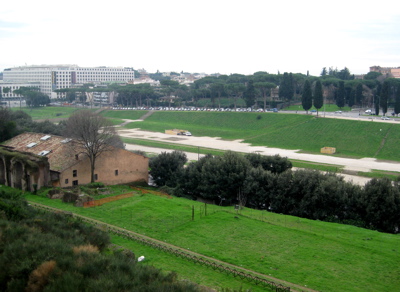
His view? The Circus Maximus.
The largest structure in the forum is the Basilica of Constantine. The word basilica didn't have religious connotations until Constantine had that structure turned into a site of worship and thereby the shape of the basilica became what it is today.
The last structure to be built in the Forum, in the 6th century, was the Column of Phocas.
The Forum we see today is only the older part of the Forum. The forums of August and Trajan, survived in some form until the 1930's when Mussolini tore it up and paved it over with a huge road. The markets of Trajan still exist, but those structures of the Ancient world are gone.
I write all these historical notes as a way for me to learn the history for myself so I'll remember it for my Art History quizzes. You need not read all the text but just look at the pictures and captions.
Because my work was all done as preparation, I got to spend the day on one of the other trips and I chose to join the group visiting the Roman Forum. The legend goes that Rome was founded on the Palatine Hill by the twins Romulus and Remus back in 753 BCE. The flat area at the base of the hill became the Roman Forum, where many public buildings and houses of worship were built over the course of the next 1,000 years, most of them being erected at the time of the height of the Roman Empire, the first first few centuries CE.
I know about the Vestal Virgins (VV) from the line in the song "A Whiter Shade of Pale" but what were they. There were six VV who were selected at age 6 from the elite Roman families. For 10 years they trained to carry out the duty of keeping the flame in the temple going. The flame represented the founding of Rome or something of that nature. 10 years of duty and then 10 years of training the next set of VV. The story goes that is a young woman lost her virginity, she was buried alive.
The great Augustus (adopted son of Julius Caesar) consolidated power and became the first Roman Emperor and he died in 14 CE he was succeeded by a succession of rulers called the Julio-Claudians, the last of which was Nero, who was in a word INSANE. The great Roman fire of 64 CE, which some think Nero set himself, burned a majority of the city. In the wake of the fire, Nero appropriated for himself much of the prime real estate to the east of the Forum and much of the Esquiline Hill to build his grand Domus Aurea, or his Golden House. This house had a kilometer long colonnade and a huge naked statue of himself. Nero could make it this large because of the new material, CONCRETE. Nero committed suicide in 68 CE.
Vespasian, in a brilliant political move took Nero's fish pond and gave it back to the people of Rome in the form of the Colosseum, a public space. Vespasian understood the idea of "Bread and Circus", keep your subjects fed and entertained and they'll be happy.
During Vespasian's rule, his son, Titus, won some major victories, the key being conquering Jerusalem. Titus, unfortunately for the Roman people, lived for only two years after being installed as Emperor in 79 CE. During his two year reign, he had to deal with the eruption of Vesuvius. After his death in 81 CE, the Roman Senate bestowed "god" status to Titus and they erected a triumphal arch to him.
The reason the Colosseum stands today is that in the 4th century Constantine planted a cross inside the structure and declared it a Christian building, therefore it wasn't ever looted or quarried for other buildings.
The Forum we see today is only the older part of the Forum. The forums of August and Trajan, survived in some form until the 1930's when Mussolini tore it up and paved it over with a huge road. The markets of Trajan still exist, but those structures of the Ancient world are gone.
I write all these historical notes as a way for me to learn the history for myself so I'll remember it for my Art History quizzes. You need not read all the text but just look at the pictures and captions.
Subscribe to:
Posts (Atom)