Friday, March 05, 2010

Villa Adriana

Hadrian, one of the top 5 greatest emperors of the Roman Empire, traveled throughout the Empire to take stock the vast wealth and resources in its domain. What Hadrian also did was bring back to Rome parts of different cultures that he liked and built a retreat, known both as Hadrian's Villa and Villa Adriana, for himself in the hills east of Rome.


It was the Las Vegas of its time and spanned an entire square mile.


Here's the large pool complex with the hills in the background.


Hadrian, himself an accomplished architect, designed these round domed structures. His architect made fun of them and called them "pumpkins" and was fired from his position and eventually executed. The holes you see had hooks in them to hold up the beautiful ceilings that one would see from inside this bath.


A "pumpkin" vault still intact.


The most famous part of the complex was this "maritime theater. It was a circular colonnade which had a round pool in which stood an island that could only be accessed by a drawbridge.


Once again, I personally get to see something we studied in Art History class.


All SYA Italy students will know what this picture is about and who it is in honor of!


And here they are doing their pose in honor of Augustus at Hadrian's Villa.

Thursday, March 04, 2010

Time to repay Mom and Dad


I'm 40 years old and in my lifetime, I have inherited 5 cars from my parents. In fact, I bought a house before I ever bought a car. Since, my car is sitting in my sisters garage, my parents are now taking my car for themselves. For those keeping score, I'm now down 4.


To do it officially, I had to have it notarized here in Italy. I had to go to Rome to go to the consulate at the United States Embassy (Hillary Clinton's picture was on the wall!). It's in quite a posh part of town and I snapped this picture of it before the policeman in the bottom corner of the photo told me to stop.


So, the DMV in Washington State is going to get a form notarized by a civil servant in Rome, Italy and is embossed with the seal of the United States of America.

Wednesday, March 03, 2010

El Djem


The last stop on our visit to Tunisia was the amazing well preserved Roman amphitheater at El Djem.


It was built in the 3rd Century AD by the Roman consul, Gordian I. Because of the dry arid, climate, it has survived almost intact to the present.


The amphitheater was used for gladiator shows and chariot races. Here is the staging area underneath. It also has a working well.


The amphitheater could hold up to 35,000 spectators, the third largest in the Roman Empire.


The amphitheater might not actually have been finished, but was partially destroyed in the 17th century.


Randomly, here's how dates grow!


A beautiful island off the coast of Tunisia as we embarked on a 26 hour boat ride back to Italy.

Tuesday, March 02, 2010

A Latin Teachers Dream Come True


CARTHAGE!! Founded originally by Queen Dido of the Phoencians back in the 9th Century BCE, it is sited on a spit of land in modern day Tunisia. The Punic Wars (between Carthage and Rome) were epic wars, with Carthage being burned to the ground after the 3rd Punic war. By the way, my Latin recitation was one where Aeneas breaks up with Dido to go found Rome. She puts a curse on Rome, most likely leading to the Punic Wars.


The remains of Carthage are limited to these Roman Baths built when the Roman Empire ruled this area. Modern day Carthage, an upscale suburb of Tunis, most probably sits on top of a wealth of archeological sites.


These baths in Carthage were the third largest built in the Roman Empire. The site, here on the water, thereby making it a naval power, is so good that the Royal Palace of Tunisia sits just to the north of this UNESCO site.


That's our Latin Teacher, Frank T. realizing a lifelong dream and seeing Carthage in person.


Monday, March 01, 2010

Bardo Museum of Tunis


Welcome to Tunisia!


First stop, the Bardo National Museum, home to some of the most beautiful and important mosaics in the world. This one is from before Islam became prevalent in North Africa because it depicts animals and living things.


This huge floor mosaic is in the process of being transferred onto a wall. Quite and undertaking.


The students all recognized this mosaic of Vergil, flanked by two of his muses, and a copy of his Aeneid in his lap. This is the cover of Wheelock's Latin Grammar book, the one the beginning Latin students are using.


This is a chandelier, but I just couldn't figure out how to get it into the picture.


While in Tunisia, we were with guides the entire time. Our guide tok the group into the Medina of Tunis. A nice tour but he took the group into a perfume shop of a friend of his. Effective as most students left with a purchase.


I am a huge fan of Islamic doors.

Sunday, February 28, 2010

Cappella Palatina

So, after the church at Monreale, we retained the same guides (talk, talk, talk......) for the rest of the afternoon and visited the Cappella Palatina (the chapel in the Norman Royal Palace), the Duomo of Palermo and a fourth church. Everything in the afternoon was done by earpiece and wireless microphone making any comprehension impossible. So, while I still had any motivation, I purchased a little English guidebook for the Cappella Palatina to give me some understanding of what I was looking at. But after that, I didn't even keep the earpiece in and I exercised my option as a teacher to simply walk away and not pay attention. I was the envy of the students.


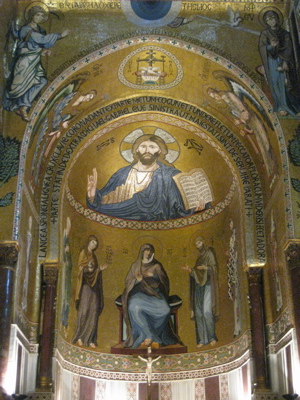
The apse of the Cappella Palatina. Similar iconography, material, etc. as the apse at Monreale.


At the back of the nave is a throne area.


Porphyry, or purple marble, only comes from Egypt so having it installed in one's church was a sign of power and wealth. It's beautiful and has such a sensuous feeling to the touch.


The whole chapel is filled with biblical scenes and for someone like me who never went to Bible school, the stories are lost on me.


A frieze of mosaic palms run the perimeter of the chapel.


The coolest thing of the chapel, and the photo just doesn't capture it, are the "muquarnas" of the nave ceiling. These are wooden stalagtite type things that form a 3-D fractal pattern.


The duomo of Palermo and at this point, I checked out.


This is a famous fountain that we walked by from one church to another. Can't say much about it.


We had some free time at the end of the day and I found this sign which is a monument to all those who have tried to fight the mafia. Only in Sicily...


Leaving Sicily on a boat from Tunisia, you can see why Palermo is called "The Golden Shell" as it is enclosed by a circle of mountains. Our 8 hour trip from Palermo to Tunis was rocked by heavy winds and strong waves. Seasickness was the theme.

The "Mash-Up" Church of Monreale

Moving from the Greeks of the 5th Century BC, we now have an interlude to visit the great buildings of Norman Sicily of the 12th Century AD. The Normans, the French descendants of the Vikings, took advantage of the power vacuum in the Mediterranean at the time and established themselves in Sicily. The Norman kings built this church about 12 km south of central Palermo high in the hills. I have to admit that on this day, our guides were completely incomprehensible too me as they spoke for 30 minutes at a time in rapid Italian. I got about 10% of it and the rest I just dozed off. The study of Byzantine art means lots of mosaics, flat figures and scenes of Jesus and whatever rules co-mingling to indicate church and state head being one and the same. I think that's the gist, but I might be wrong as I kind of zoned out during this part of Art History class.


You walk into Monreale and are taken by the sight of Christ as pantokrator, ruler and judge of Heaven and Earth. This is clearly a Byzantine form of art, but it is place in an semi-dome apse at the end of the church. Traditional Byzantine churches have hemispherical domes at the center of the building. This is also a step away from the Greek and Roman worlds where temples were built to worship in a monastic way, whereas this is the glorification of monarchs.


The layout of the church, is a large cross, with a long nave and apse along the longitudinal axis. In addition, the nave as corridors to the side of the central seating area.


The church at Monreale, unlike many churches of the time that were created and finished over long periods of time, was erected and decorated in a short span of time, about a decade. The Norman kings, used Islamic workers who put their own touches on the churches with their amazing geometric mosaics.


So, we have a Christian church, with Byzantine art, church/state overtones and iconography, built and decorated with Islamic details. Mash-up.


Upon closer inspection, you can see the amount of labor done by the the workers. These tilings aren't perfect in the least. No mechanized stone cutting here. Each piece was cut and placed by hand.


Being a Geometry teacher, the mosaics and tilings were most interesting to me.


I want to say that each and everyone of them was different, but I didn't actually look closely enough. The general effect was what we call in Art History class, "spallodire", or "WOW."