Back in February, I read The Omnivore's Dilemma by Michael Pollan. My friend from Cornell, Peter (who is the only person in the world I grant the privilege of telling me to read a book point-blank, no questions asked) raved about it as well and so we embarked on a quest to spend part of our summer (and our fourth Ernie-Peter extravaganza) working on farms. Some of you may not think getting up early and doing farm work as a vacation, but for Peter and I, the joy comes in the learning and the doing. I can speak for myself, in that sitting on a beach does little to interest me.
Peter (note I was a complete free-rider in the actual preparation for the trip as I simply showed up and had my fun) contacted four different suppliers of his favorite restaurant in Brooklyn and we chose to volunteer a week each at two of them. The first, Lucky Dog Farm, is located in Hamden, NY which is in Delaware County in the northern reaches of the Catskill Mountains. Lucky Dog is run by a couple (he a native of Mississippi and she of Texas) who left New York City eight years ago to establish an organic vegetable farm on 150 acres (he has 40 planted this year) hard against the West Branch of the Delaware River.

My tent, pitched in a field at Lucky Dog Farm

The view from my tent

The river behind our tents was our nightly bath.
Starting Monday July 30th, we were up at 6-7AM in the fields working with the six other workers he employs. We weren't treated any differently or given easier work, it was get out there and do the same work as all the others. It was great.

All produce starts as a seedling that is placed in a mud/soil mixture in the greenhouse. After the seeds have taken root, each is transplanted (as I am doing above) into a larger block of mud/soil.

The blocked seedlings are then let to grow to a size in which they are ready for planting.

The seedlings are then planted with a mechanical transplanter. According to Peter, this was the most stressful job he had all week (I didn't get an opportunity on this contraption). He had to drop the blocked seedlings into a hole in the machine which would open up a row of soil drop the seedling block in and then cover up the row with soil.

Tomatoes and flowers were grown in the greenhouses
Throughout the week, each an every day moved quickly because we never had to focus on one task for more than an hour. There was one exception but I will discuss that later. As a group we harvested at least four types of kale, swiss chard, five types of beans, tomatoes, fava beans, arugula, beets, five types of lettuce, salad mix, carrots, potatoes, cauliflower, broccoli, three types of onions, many types of squash and more that I'm forgetting.
The rhythm of most days has the crew harvesting crops in the morning. On Mondays and Wednesdays, the farm has an order from an organic produce distributor who supplies to NYC restaurants. Richard, the owner, tells the distributor what he has and then is told what is needed. On Thursday, harvesting is dedicated to the farm run Community Supported Agriculture service in which local residents prepay for seasonal goods which they come and pick up. Friday harvesting is geared towards the selling at the three farmers markets the farms sell at over the weekend.

The microclimate of the valley in which the farm is located consistently has dense fog in the morning until about 10AM. Here we are cutting arugula (the green row on the right) and some red lettuce as well. Notice that the arugula is covered with a synthetic cloth. Bugs like spicy leaves and so the arugula needed to be covered.

I am on the ground cutting green salad mix

After an hour of cutting, I've got a full crate ready to be washed and packed.

Richard G. the owner of Lucky Dog Farms with a bunch of freshly picked laccinata kale.

Micah with a full crate of redbor kale.

There are many machines on the farm which make life a great deal easier. Shown here is a potato harvester, which digs up the potatoes then shakes loose the dirt...

...and the drops them on the top of the upturned soil.

The last step is to get on ones hands and knees and pick up all the potatoes.
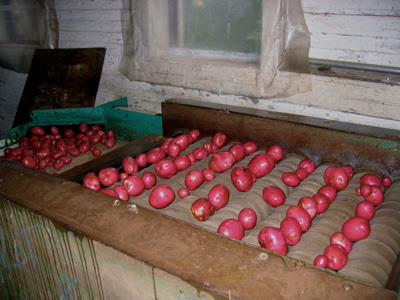
Another amazing piece of equipment, the potato washer.


This machine simply is driven over a patch of beans and miraculously separates them from the plant...

...then drops them in a crate.
Remember how I mentioned one task that we did for hours on end? That task was bean sorting. The following pictures shows Peter and another worker standing at the side of a table with grooves. The table sloped to the left and shook semi-violently to keep the beans moving towards the edge of the table. Our job was to pick out the short/broken/ugly beans or to pick out the stems and leaves that made it through the harvester. Each crate took about five minutes and was sent through the sorter twice. One day we did 15 crates, another day 20, but on our last day, we sorted 36 crates of beans.

The bean sorting table.

A picture of the washroom before the days harvest is unloaded from the trucks to be washed and boxed.

Purple cauliflower ready for washing.

Micah, myself and Calen at the end of a long week.

On the Saturday we left, Peter and I helped out at the on of the farmers markets that Richard sells at. This one was in Margaretville, NY.
So that's a whirlwind look at life on an organic vegetable farm. So what did I take away from the experience. First and foremost, I am in awe of photosynthesis. Plants are planted and given some sun and water and these amazing edible plants are produced. Second, I never understood how much thought and work goes into producing our food. Richard has to think so much in advance of when to start seeding plants to make sure that they are in season and will ripen at the right time. I will never be able to buy my vegetables again without thinking of Richard, Micah, Calen, Calen's sisters and Jill and all the hard work they put into growing and getting the food to us.
When my friends and I were studying at Cornell, we used to laugh at the major titled Agricultural Engineering. Well, no more of that for me. Machines make things so much easier on the farm. However, they are expensive and even more costly to maintain. This cost along with the amazingly low prices we pay for food as well as the huge subsidies the government gives to large farmers makes the Economics of small farms very difficult. It's still cheaper to buy produce in NYC that is shipped from California that from Lucky Dog Farm only three hours away from the city. We need to support our local farmers, and most of the time organic as well, by being willing to spend the time asking where our food comes from and being willing to pay more for it.
I end by telling you about the revelation I had at eating locally grown food. Each and every meal at the farm was like a "Vegetable Iron Chef". One night I ate a tomato that was grown right there on the farm and it blew me away. I had never eaten a Black Krem before. Food from the farm, food that isn't grown in mass quantities as is what we often buy at our local big grocery store, takes infinitely better. Perhaps I am late to this bandwagon, but I am certainly on it now!!
Peter (note I was a complete free-rider in the actual preparation for the trip as I simply showed up and had my fun) contacted four different suppliers of his favorite restaurant in Brooklyn and we chose to volunteer a week each at two of them. The first, Lucky Dog Farm, is located in Hamden, NY which is in Delaware County in the northern reaches of the Catskill Mountains. Lucky Dog is run by a couple (he a native of Mississippi and she of Texas) who left New York City eight years ago to establish an organic vegetable farm on 150 acres (he has 40 planted this year) hard against the West Branch of the Delaware River.


Starting Monday July 30th, we were up at 6-7AM in the fields working with the six other workers he employs. We weren't treated any differently or given easier work, it was get out there and do the same work as all the others. It was great.


Throughout the week, each an every day moved quickly because we never had to focus on one task for more than an hour. There was one exception but I will discuss that later. As a group we harvested at least four types of kale, swiss chard, five types of beans, tomatoes, fava beans, arugula, beets, five types of lettuce, salad mix, carrots, potatoes, cauliflower, broccoli, three types of onions, many types of squash and more that I'm forgetting.
The rhythm of most days has the crew harvesting crops in the morning. On Mondays and Wednesdays, the farm has an order from an organic produce distributor who supplies to NYC restaurants. Richard, the owner, tells the distributor what he has and then is told what is needed. On Thursday, harvesting is dedicated to the farm run Community Supported Agriculture service in which local residents prepay for seasonal goods which they come and pick up. Friday harvesting is geared towards the selling at the three farmers markets the farms sell at over the weekend.


Remember how I mentioned one task that we did for hours on end? That task was bean sorting. The following pictures shows Peter and another worker standing at the side of a table with grooves. The table sloped to the left and shook semi-violently to keep the beans moving towards the edge of the table. Our job was to pick out the short/broken/ugly beans or to pick out the stems and leaves that made it through the harvester. Each crate took about five minutes and was sent through the sorter twice. One day we did 15 crates, another day 20, but on our last day, we sorted 36 crates of beans.


So that's a whirlwind look at life on an organic vegetable farm. So what did I take away from the experience. First and foremost, I am in awe of photosynthesis. Plants are planted and given some sun and water and these amazing edible plants are produced. Second, I never understood how much thought and work goes into producing our food. Richard has to think so much in advance of when to start seeding plants to make sure that they are in season and will ripen at the right time. I will never be able to buy my vegetables again without thinking of Richard, Micah, Calen, Calen's sisters and Jill and all the hard work they put into growing and getting the food to us.
When my friends and I were studying at Cornell, we used to laugh at the major titled Agricultural Engineering. Well, no more of that for me. Machines make things so much easier on the farm. However, they are expensive and even more costly to maintain. This cost along with the amazingly low prices we pay for food as well as the huge subsidies the government gives to large farmers makes the Economics of small farms very difficult. It's still cheaper to buy produce in NYC that is shipped from California that from Lucky Dog Farm only three hours away from the city. We need to support our local farmers, and most of the time organic as well, by being willing to spend the time asking where our food comes from and being willing to pay more for it.
I end by telling you about the revelation I had at eating locally grown food. Each and every meal at the farm was like a "Vegetable Iron Chef". One night I ate a tomato that was grown right there on the farm and it blew me away. I had never eaten a Black Krem before. Food from the farm, food that isn't grown in mass quantities as is what we often buy at our local big grocery store, takes infinitely better. Perhaps I am late to this bandwagon, but I am certainly on it now!!


