Thursday, May 19, 2011
Giro di Italia 2011

Furlo along the Via Flaminia
Tuesday, May 17, 2011
An Afternoon in the Gardens of Versailles
Monday, May 16, 2011
Chartres Cathedral
The Cathedral at Chartres has three pages dedicated to it in Gardner's. Why? It's one, if the the best, preserved original French Gothic (1100-1200's) church. It survived the French Revolution and two world wars.
The West Facade with the Royal Portal. The original church was built in 1145, but most of the original church burned in a 1194 fire. The Royal Portal shows the majesty and power of Christ.
The engineering development of the Gothic age, flying buttresses, which allowed support to not build a higher ceiling...
....but to create more space for windows to let in light.
Looking towards the west, the south (shorter to the left) tower was built in the Romanesque style and survived the 1194 fire. The taller north tower was originally built of wood and burned in the 1194 fire and rebuilt.
A feature of gothic churches, diagonal and transverse ribs.
The north portal door tells the story of Christ from birth to crucifixtion.
The south portal projects out more forcefully into the public space.
It shows Christ up to the present and is the personification of the triumph of Christianity.
Unlike Greek caryatids, who ARE the column, the saints here in the portal jambs are distinct artistic adornments because they are independent of the columns themselves.
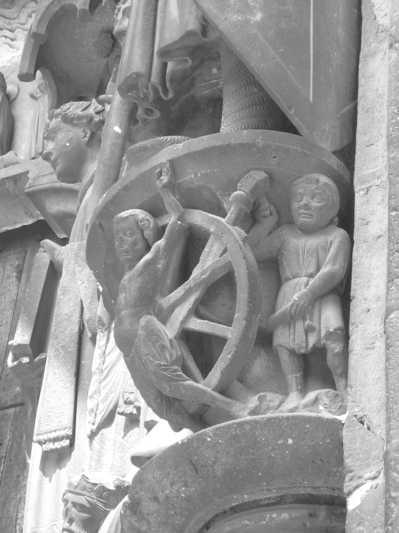
Also depicted are methods of torture, such as someone being stretched on a wheel.
The ambulatory inside encloses the choir.
The choir screen depicts the life of Mary.
This lancet window (called the Blue Virgin) survived the 1194 fire and was reinstalled in the rebuilt church. Virgin Mary and child with a red background and angels in a blue background. With the flat frontal depiction of Mary, it harkens back to the Byzantine. But one difference is that with stained glass, the light shines in from the back, where with the dazzling display of the Byzantine mosaics, the light comes from the front and shines off the tiles. Interesting.
Over each of the portals (north, west and south) are huge rose windows. They each tell a story. The feel inside with the darkness from the stained glass, but enough to be able to move around, especially on a sunny day, sets the right mood to let any human know that they are in the presence of God.
Chenonceaux
From Brittney, Marlene and I drove into the Loire Valley to visit Chenonceaux, the 16th century the home of French King Henry II's mistress Diane de Poitiers. When Henry IInd died in 1559, his wife, Catherine de Medici expelled Diane and forced Catherine forced Diane to trade it for another chateau. All very messy and much like a soap opera....
Here we are on the path that leads to the River Cher over which...
...spans Chenonceaux, the chateau.
This is the de Poitier garden. On the other side there is the de Medici garden. The whole complex has an arboretum and beautiful parkland. Bonus, we arrived after 5PM and it was uncrowded. Bummer, it was overcast.
Why the picture of this door?
Turns out that the River Cher was the border between Occupied France (north) and Free France (south) during WWII. Therefore this door and gallery was used to shuttle people back and forth between the two parts of France.
Sunday, May 15, 2011
Carnac
Thursday, May 12, 2011
Between Normandy and Brittney
Leaving the Normandy beaches and countryside, Marlene and I headed west first to Mont-St-Michel and then to the region of Brittney, the "arm" of France that sticks into the Atlantic Ocean. It was a peaceful and quiet few days. And, as was true throughout, the weather was beautiful.
The famed Mont-St-Michel abbey. Ever since I saw it on the cover of my friends' French books back in Middle School, I've wanted to see it.
Having seen enough abbeys/churches/castles living in Europe, the tour was interesting, but the only real thing I found cool was the causeway linking the island to the mainland.
Crossing into Brittney, near the town of Cancale, we stopped for oysters by the side of the road. This part of the coast of France is famous for oysters.
Turns out, I like the bigger oysters, rather than the small/baby ones.
We ended that night in St. Malo, a walled city on the water. Beautiful sunset......peaceful.
Subscribe to:
Posts (Atom)