Sunday, August 26, 2007

Flying Pigs Farm

The second stop on the Peter and Ernie agricultural tour took us to Flying Pigs Farm located on the New York/Vermont border in Shushan, NY. The owners, Mike and Jennifer, started this farm after having moved into a house and renovated and while working their full time jobs, bought a couple pigs and raised them. A few years ago, they dove in to raise pigs and chickens full time. I will put in a plug for them and make sure to check out their website and if you are a lover of pork products, make and order and they'll get the goods out to you pronto.


I start with a shot of the morning sun over Vermont as seen from my tent.


I'll start with pigs. The process of raising pigs is pretty simple. You feed them to "fatten them up" and when they are large enough, it's off to the slaughter house. The pigs are separated into three different areas based on their size. The farm purchases the piglets from others who breed them, Flying Pigs raises them until they are marketable. While Pete and I were on the farm, two other workers drove to pickup a new set of piglets. Apparently, the handover took place in a Home Depot parking lot. That must have been a sight to behold.


Mike unloading a newly obtained pig into the small pigs area. Once you catch a pig, you can hold however you want but it will truly "squeal like a pig"


Pigs and chickens eat tons of feed. A two ton delivery of feed comes twice a week to fill up the feed truck.


The feed truck is then driven up the hill to the pig areas and feed is augured into the feeding units.


Myself after filling the pig feeders.


The pigs chowing down. As you can see they stick their entire faces under the plastic lid to get to the food. When the pigs pull themselves out, the door slaps down to make a distinctive sound. When all the pigs are eating, the collective shutting of doors is like a rhythmic drumbeat.


Daily chores include filling the pigs water jugs, making sure that the feeders were full and evenly balanced and making mud for the pigs. "Sweat like a pig" is an oxymoron. "Happy as a pig in mud" is a truism because pigs don't sweat. Therefore, rolling around in the mud is a way for them to cool off.


"Pig pile!!"


Sadly, one day during chores, we found that a medium sized pig had passed away. How did we know that it wasn't just sleeping? First off, it was laying down on the ground out in the open. If there isn't mud, pigs prefer to sleep under the cover of trees where it's cooler. Secondly, there were flies buzzing all around it. The other workers did an autopsy to try and determine what the cause was.


The smell was pretty horrendous, but the sight, fascinating.


The best guess was that the pig might have had a respiratory ailment as the lung was slightly discolored. Here I am with the lung zip-locked for Mike's inspection.


Instead of ending the section on pigs with death, instead there will be birth. When the farm takes delivery of new pigs, they are supposed all females (sows). However, a couple weeks ago, as Mike was rounding up pigs for slaughter, one of the sows was discovered to be pregnant. Apparently, one of the sows was a boar and had done his manly duty. The sow bore ten piglets and her life temporarily spared as she raises her offspring.
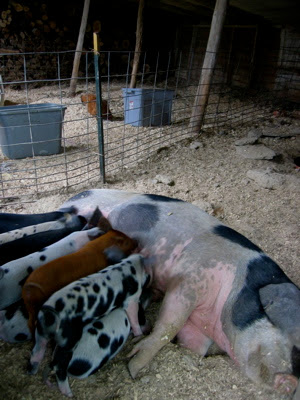


The joys/burdens of being a mother of 10.


Before moving onto chickens, I must mention that when Peter and I offered our services on the farms, we said anything was game. Therefore we were given other duties as assigned. One of them was to build a feed box for the chicken feed.


Peter nailing together the chicken feed box.


Before the box, Mike had to buy his two types of chicken feed (for the egg layer and the meat birds) in sacks. Buying it in ton form (as seen in pig feed truck above) cuts his costs by one third. In addition, because the feed is now located closer to the chickens, less labor is involved.


Chicken feed being loaded into the new box.


The farm currently stores all of it's pork and sausages in a freezer in town, a short drive away. Mike has decided to build a freezer building on his property and so Peter and I helped with that as well.


Here's the new freezer building as we left it.


Onto the chickens. Chickens are creatures of habit. Granted all of us are, but chickens especially. Chickens have been bred for two purposes, to provide us eggs and to provide us meat. They are kept separately based on their ultimate function.


This small white chick is a future meat chicken.


Mike and Peter laying out the electric fence to enclose a new area for the meat birds. Moving the birds to a new area is both an issue of sanitation and a source of new bugs for them to eat. The fence itself is more to keep predators out.


Kristy and Matt (the other workers who are on a vet school internship) helping set the fence.


Then it's time to lead the chickens to their new home.


Sometimes you do what you have to do. When you pick the chickens up and hold them upside down, they become docile.


The laying chickens are allowed to roam (free range, baby) during the day and of course they dug up the dead pig in the mulch pile.


A "hen-pecked" chicken. When the chickens get stressed or agitated they start plucking out each others' tail feathers. Those who are completely stripped of their hind feathers are lowest on the "pecking order".


The chickens only lay eggs during the day. The laying chickens have two buildings (on wheels of course to move between areas). One is their roost, where each evening when the sun goes down, the "chickens come home to roost". Their other building is the egg barn as I call it. Inside are metal boxes in which the chickens lay their eggs.


The egg barn


Due to bacteria and disease reasons, the sheels of the eggs must be sanitized before sale.


Then the eggs are sorted by size and color for sale at farmer's markets in NYC. Some of the eggs we sorted while working went to some specific high-end restaurants.


So you hopefully noticed that throughout this posting, I put certain sayings in quotes. One of the things Peter and I noticed is how many sayings we use today are rooted in agriculture. These quoted sayings are only the ones we found ourselves while at Flying Pigs. But there must be many more that we didn't notice.

A great shout of of thanks goes to both Richard and Holley as well as Mike and Jennifer for their great hospitality. We never ate poorly and had such an amazing education about both the workings of farm life as well as the struggles and joys. Although vegetables and animals require vastly different types of work, but the pride these two farms (as well all farms across this country) have in their product is what I found to be their ultimate appeal. Never will I again purchase my food without at least thinking about the work it took to grow the produce and meat. But also what happens to those natural products as they get processed into other forms.

Friday, August 24, 2007

An Interregnum

After the Margaretville farmers market, Peter dropped me off at the Kingston, NY bus station and I took Greyhound to the Albany Airport where I rented a car for the week. This posting will be mostly a list of things I did for my own memory when I come back to read this. It might not be interesting to many readers but there will be little moments of wisdom along the way for those who read.

My first stop was visiting Andy V., friend from Geology. Three years ago, I came through Niskayuna (a suburb of Albany) and hung out with his three children. Only the oldest remembered me. Andy invited his friend John who I met 13 years ago in Philadelphia and his wife. We ate out of Andy's new, self-built deck and then played and wicked game of Presidents.

I then drove to Vermont to visit my former adviser (and still life-adviser) Anne S. Sadly, her husband Dave has succumbed to a brutal brain deterioration disease much like Alzheimers. However, because he suffered a mass brain trauma, much like a stroke, he has also lost some bodily control as well. In short, David doesn't engage or emote. Anne and I chatted at some length about the pain of essentially losing a spouse but still having to physically take care of him. The ONE saving grace about the entire situation is that David appears to have no idea that he is a changed person. From what I know of Alzheimers, those sufferers do have moments of lucidity and know that they are changing.

While in Vermont:
•A visit to the state capital in Montpelier
•Dinner and Ed and Curtis K's in Brookfield
•Visit to Thistle Hill Cheese

The next stop was Topsfield, MA to visit Catherine, Joe and their son Leo. Catherine and I took a jaunt to Newburyport and a nice day in Gloucester and Halibut State Park on the tip of Cape Ann. While in Gloucester, I wanted to take a tour of the Gorton's fish processing center. However, according to the headquarters, it isn't open to the public. My immediate suspicion is that the company must import it's fish from China!!


The Topsfield town flag hanging in the great hall of the Massachusetts State capital building in Boston.


After a day in Topsfield, I returned the rental car to Logan Airport and met Jeff O. at his office which is in the same building as the Federal Reserve of Boston. We had dinner at an Indian restaurant in Davis Square and then spent the evening howling at a Japanese TV show Ninja Warrior, which has contestants work their way through ever increasing obstacle courses.

The next day, I visited the JFK presidential library. I found it to be quite skimpy on the events of his tenure. It simply skipped any mention of the Bay of Pigs but glorified JFK's role in the Cuban Missile Crisis.


The JFK Presidential Library in Boston


The 1960's Electoral College map. Fascinating how things have changed and stayed the same.


After paying $15 to the Fung Wah Bus company, affectionately known as the Chinatown Bus, I landed in NYC for a long 4 day weekend. After truly falling in love with NYC last summer, I continued my "I HEART NEW YORK" love affair.

However, I did make a trip to Philadelphia to visit a former student who has done a wonderful job of staying in touch. While in Philadelphia...

•Lunch at Delilah's in Reading Terminal Market
•Visit Peilin's office
•Bench sitting in Rittenhouse Square


The bar on the ground floor of Peilin's building on 13th Street. There is a theme here. The answer at the end of the posting.


Peilin at her friends' block party in South Philadelphia.


Bowling with Simon R. and Lindsay A. (what is it about the HRS class of 2001 and me?) at Lucky Strike Bowling. Note Simon's pre-throw pose.


My first game scoring over 100. I now know how to score in bowling, it only took 37 years.


At the end of the Philadelphia day, Jim J. picked me up and we went to the Raven in New Hope, PA to meet up with friends and I stayed the night at Lawrenceville.

Back in NYC, I met up with Ian M. and we saw the musical, 25th Annual Putnam County Spelling Bee. The musical was enjoyable, however, I realized that I am not as entranced by those musicals in which the songs are simply just singing the lyrics. Productions like Mamma Mia or Jersey Boys, granted the songs were written before the musicals were created, are songs. Even older musicals, such as my favorite Oklahoma have songs, not just sung dialogue.

A weekend in New York City....
•Dinner and drinks with Evan B. and his friend Jimmy
•Dinner with Sim and his girlfriend at a French restaurant on Atlantic Ave.
•Frog Exhibit at Museum of Natural History with Gayle A. and her sister
•United Nations tour with Gayle A. and her sister
•Dinner at Fred's in the Barney's store (get it?) with Jennifer C.
•A morning with the NY Times and a bagel on the Brooklyn Promenade
•Filming of a field hockey scene from episode 3 of the CW's Gossip Girls
•Walking across the Brooklyn Bridge
•Shopping in Soho
•An afternoon in Washington Square Park
•Drinks with Evan B. and Emily D.
•Meet the farmer dinner (Holley and Richard of Lucky Dog) at Applewood

So I promised a pearl of insight and wisdom at the beginning of this post. Right now in my life, I feel like there is something missing that I can't put my finger on. In my conversation with Sim, I realized that what I miss is my "clan". The easiest analogy would be the characters on the show Friends. With your clan, it's never having to schedule something to do, that's unspoken. The issue is always what your group is going to do. With so many of my friends married, with kids or simply coupled off, it's always dueling calenders to even see them, let alone do something more than get together for dinner.

I'm sad about this situation, but it's the reality and perhaps it's my job to try and recreate this in some altered fashion in my SF life at this time. But the one heartening thing was that I realize that I at one point did have this in my life. Back in my "miserable" grad school years in Baltimore (93-95), the miserable part was school, but in reality I did have a "clan". The guys, Peter, Sim, Doug, Tom and co., on Wisconsin Avenue in DC, were my clan. Every weekend, I would be down there and we would be going off on some trip or having a BBQ. In retrospect, it was a truly wonderful and great time. We had no responsibilities other than work or school and it was an young adult extension of college. I miss that, but am glad that I actually did have it at one point in my life. The having had it is actually peace of mind for me.

Some final notes and pictures of non-farm fun I/Peter had while up on the pig farm. We spent the day at the Saratoga Race Track where I was amazed at the ease at which betting happened. I put $40 on a betting card and just by sticking into an ATM-like machine could bet on races throughout NY State and some in New Jersey as well. Since Peter and I both used the same card, our winnings got all jumbled together but in the end (with the two horses I bet on in the last race finishing 1-2) we left with $36.90. Not bad for a day at the races.


A horse being walked to its race.


The obelisk built to memorialize the Battle of Saratoga during the Revolutionary War.


Peter and I also attended the Washington County, NY fair. It was everything you imagined a county fair to be. Animal showings, rides and of course the food. However, the highlight for us was the DEMOLITION DERBY. It's exactly what you picture it to be. Drivers enter their cars and the last one moving is the winner. The best smash-up we saw was the competition between Minivans. There were only 4 entered, so the Minivans could actually gather up some speed and get some huge crunches in. This particular round lasted over 15 minutes with the winning van rolling around on it's front rims and smoking from the engine. But it was still moving!

Answer: The name of the bar is called Dirty Frank's. You will notice that each picture has the name Frank associated with it. There was even a second wall with more Frank pictures that I didn't include.

Thursday, August 23, 2007

Lucky Dog Farm

Back in February, I read The Omnivore's Dilemma by Michael Pollan. My friend from Cornell, Peter (who is the only person in the world I grant the privilege of telling me to read a book point-blank, no questions asked) raved about it as well and so we embarked on a quest to spend part of our summer (and our fourth Ernie-Peter extravaganza) working on farms. Some of you may not think getting up early and doing farm work as a vacation, but for Peter and I, the joy comes in the learning and the doing. I can speak for myself, in that sitting on a beach does little to interest me.

Peter (note I was a complete free-rider in the actual preparation for the trip as I simply showed up and had my fun) contacted four different suppliers of his favorite restaurant in Brooklyn and we chose to volunteer a week each at two of them. The first, Lucky Dog Farm, is located in Hamden, NY which is in Delaware County in the northern reaches of the Catskill Mountains. Lucky Dog is run by a couple (he a native of Mississippi and she of Texas) who left New York City eight years ago to establish an organic vegetable farm on 150 acres (he has 40 planted this year) hard against the West Branch of the Delaware River.


My tent, pitched in a field at Lucky Dog Farm


The view from my tent


The river behind our tents was our nightly bath.


Starting Monday July 30th, we were up at 6-7AM in the fields working with the six other workers he employs. We weren't treated any differently or given easier work, it was get out there and do the same work as all the others. It was great.


All produce starts as a seedling that is placed in a mud/soil mixture in the greenhouse. After the seeds have taken root, each is transplanted (as I am doing above) into a larger block of mud/soil.


The blocked seedlings are then let to grow to a size in which they are ready for planting.


The seedlings are then planted with a mechanical transplanter. According to Peter, this was the most stressful job he had all week (I didn't get an opportunity on this contraption). He had to drop the blocked seedlings into a hole in the machine which would open up a row of soil drop the seedling block in and then cover up the row with soil.


Tomatoes and flowers were grown in the greenhouses


Throughout the week, each an every day moved quickly because we never had to focus on one task for more than an hour. There was one exception but I will discuss that later. As a group we harvested at least four types of kale, swiss chard, five types of beans, tomatoes, fava beans, arugula, beets, five types of lettuce, salad mix, carrots, potatoes, cauliflower, broccoli, three types of onions, many types of squash and more that I'm forgetting.

The rhythm of most days has the crew harvesting crops in the morning. On Mondays and Wednesdays, the farm has an order from an organic produce distributor who supplies to NYC restaurants. Richard, the owner, tells the distributor what he has and then is told what is needed. On Thursday, harvesting is dedicated to the farm run Community Supported Agriculture service in which local residents prepay for seasonal goods which they come and pick up. Friday harvesting is geared towards the selling at the three farmers markets the farms sell at over the weekend.


The microclimate of the valley in which the farm is located consistently has dense fog in the morning until about 10AM. Here we are cutting arugula (the green row on the right) and some red lettuce as well. Notice that the arugula is covered with a synthetic cloth. Bugs like spicy leaves and so the arugula needed to be covered.


I am on the ground cutting green salad mix


After an hour of cutting, I've got a full crate ready to be washed and packed.


Richard G. the owner of Lucky Dog Farms with a bunch of freshly picked laccinata kale.


Micah with a full crate of redbor kale.


There are many machines on the farm which make life a great deal easier. Shown here is a potato harvester, which digs up the potatoes then shakes loose the dirt...


...and the drops them on the top of the upturned soil.


The last step is to get on ones hands and knees and pick up all the potatoes.


Another amazing piece of equipment, the potato washer.


This machine simply is driven over a patch of beans and miraculously separates them from the plant...


...then drops them in a crate.


Remember how I mentioned one task that we did for hours on end? That task was bean sorting. The following pictures shows Peter and another worker standing at the side of a table with grooves. The table sloped to the left and shook semi-violently to keep the beans moving towards the edge of the table. Our job was to pick out the short/broken/ugly beans or to pick out the stems and leaves that made it through the harvester. Each crate took about five minutes and was sent through the sorter twice. One day we did 15 crates, another day 20, but on our last day, we sorted 36 crates of beans.


The bean sorting table.


A picture of the washroom before the days harvest is unloaded from the trucks to be washed and boxed.


Purple cauliflower ready for washing.


Micah, myself and Calen at the end of a long week.


On the Saturday we left, Peter and I helped out at the on of the farmers markets that Richard sells at. This one was in Margaretville, NY.


So that's a whirlwind look at life on an organic vegetable farm. So what did I take away from the experience. First and foremost, I am in awe of photosynthesis. Plants are planted and given some sun and water and these amazing edible plants are produced. Second, I never understood how much thought and work goes into producing our food. Richard has to think so much in advance of when to start seeding plants to make sure that they are in season and will ripen at the right time. I will never be able to buy my vegetables again without thinking of Richard, Micah, Calen, Calen's sisters and Jill and all the hard work they put into growing and getting the food to us.

When my friends and I were studying at Cornell, we used to laugh at the major titled Agricultural Engineering. Well, no more of that for me. Machines make things so much easier on the farm. However, they are expensive and even more costly to maintain. This cost along with the amazingly low prices we pay for food as well as the huge subsidies the government gives to large farmers makes the Economics of small farms very difficult. It's still cheaper to buy produce in NYC that is shipped from California that from Lucky Dog Farm only three hours away from the city. We need to support our local farmers, and most of the time organic as well, by being willing to spend the time asking where our food comes from and being willing to pay more for it.

I end by telling you about the revelation I had at eating locally grown food. Each and every meal at the farm was like a "Vegetable Iron Chef". One night I ate a tomato that was grown right there on the farm and it blew me away. I had never eaten a Black Krem before. Food from the farm, food that isn't grown in mass quantities as is what we often buy at our local big grocery store, takes infinitely better. Perhaps I am late to this bandwagon, but I am certainly on it now!!

Friday, July 27, 2007

Final Thoughts on China

To the person, it seems to me the question I get asked is "How was China?" My response to that is complicated and there are different reactions to different parts of my experience there. I guess I'll take the cheap way out and express what I saw/learn/felt in a series of bullet points, instead of trying to combine them into one coherent well-crafted thematic essay.

• The first and foremost thing that struck me was how I felt like a foreigner in a foreign land, but wasn't seen as one. I could walk down the street and I would simply go unnoticed. In places like Europe, perhaps it is my self-perception that I'm being looked at like a tourist, but in China I was one of 1.3 billion. Sometimes I could even get away with speaking and they wouldn't bat an eye. However, when it came to having to read something, I totally was nailed and had to confess to being an American. It is truly different to be in the majority as to being in the minority The different is subtle but present. One funny story. I was at an internet cafe, typing an email and I look up and realize there are five people standing around me watching me in awe as I type not in Chinese. Yeah, I outed myself at that point too.

• Yes, China is an economic superpower. It's amazing to see how rapidly China is making progress in a traditional modernization way. We learn in Economics that developing countries start by manufacturing textiles and consumer items and move into high technology goods. China is racing along this path. Why is it happening here is a question I asked myself and lots of others have as well. I'm not a foremost expert, but from what I saw, the people of China are willing to do what it takes to achieve prosperity. They are taking advantage of the fact that the basic tenets of a free-market system are in place, private property rights, justice and then beginnings of meritocracy.

• What about all those left behind in the economic wake? I constantly thought about that. What about those people in the rural areas? The one thing that I heard was that this economic development has made hunger a relic of the past. Poverty surely still exists, but people going hungry is not nearly as endemic as in times past. The rising economic tide isn't raising all boats at the same rate. I wondered if there would be resentment and hostility to this fact. There certainly is a huge urban/rural divide in China and it's growing. I'm not sure how it will play out. It certainly is going to be a major issue in the decades to come.

• Pollution and the environment. Yup, it's huge. First of all, the country needs to install more public trash cans. One just can't help tossing trash onto the ground. It's an ethic that exists and will hopefully change. Environmental standards just aren't up to standards that we have and expect in the West. I guess what struck me as amazing was how the laws that we have implemented herein the West do work. All these emissions standards and regulations do make our air cleaner. What I do know is that we can't mandate China to do what we now know is right. Everyone and every country needs to make mistakes and learn from them. But hopefully, they will be willing work at developing their economy while maintaining the natural beauty and ecosystems that make the place so unique.

• Then there is this trade surplus that China runs with almost every country. From what could see, I don't think the majority of Chinese residents can afford anything that we can offer them. They can manufacture or grow everything themselves and for cents on the dollar. Their lives are simpler and simply don't need as much stuff, so of course they're going to export more and not need to import.

• Lastly, on a personal revelation, I have to say that spending two weeks in China opened my eyes to the fact that all those weird things my parents do and eat are what people do in China. As a child I always looked on it as something kind of extraneous in my American life. It felt like this additional stuff I had attached to my person but I never really understood how the food and the language were comforts to them. I never really understood how difficult it must have been for them to be young adults and simply moved to a completely different culture and have to assimilate. Almost every hour or so I would stop and think, "could I chuck it all and move to this country? What would I have to give up and what would I have to endure?

Overall, my trip to China was more than I could have expected. It was truly something I needed to experience and see.

Tuesday, July 24, 2007

The Li River

Being the geologist that I am, the beauty of the karst topography of the Li River has always drawn my attention. One of the highlights of my trip was getting to see this beautiful place.


We now are going to play a guessing game. One of the great traditions of cruising the Li River from Guilin to Yangshuo (which, by the way is much overrun by Westerners,a fact that I found disturbing and unsettling but more on that later) is to look at the shapes or staining on the rock faces to find items that others might identify as well. So, I'm going to present to you four pictures and see if you can figure out what shape or image people see. Answers revealed at the end of the post.


A


B


C


D


Now for the big challenge. Shown below is the rock face of nine horses. Legend has it that if you can find the nine horses you are something special. What that special is, I couldn't figure out in my conversation with John, but well, let's just say you're cool.


Find nine horses


Moon Rock Hill


The backside of the 20RMB bill


See anything familiar?


ANSWERS: A) Horse facing left and a rider facing backwards B) Apple C) Tortoise walking uphill D) Rooster