Wednesday, September 04, 2013

Dubrovnik

Driving from Mostar to Dubrovnik, there are these huge tombstones, pre-medieval according to the guidebooks.

Travels with Brian!  Always fun.  When driving, Brian saw a turtle crossing the road.  So of course we had to stop and help the little guy out.

Eventually, we got him across the road, but not after flipping him over and having a bit of fun with him!

Throughout the former Yugoslavia, they are trying to be all encompassing by writing in cyrillic as well as Roman alphabets.  Not everyone is happy about it though.

Leaving Bosnia and entering Dubrovnik on the 1st of July, 2013, we got stamped with Croatia's new EU stamp.  And then....over the crest of the hill, Dubrovnik.  Stunning!

The view from the wall.  You'll see the new red tiles.  Those are the ones that had to be replaced after the bombing of Dubrovnik in 1992.

Brian and I found a fantastic small hostel/hotel run by a Croatian woman who spoke Italian.  I surprised her with my Italian and we got really great treatment because of it.  Email me if you want the details of the hostel!


The main street, the Stradun!

The Stradun at night!

The city walls are completely in tact!!!

There is a funicular that takes you to the top of the hill above town.  From here you have an amazing view of the city....here's at dusk the lights are turning on!

And a killer sunset over the islands off the Croatian coast.

At the point on the southern end of the harbor is the former Hotel Belvedere.  Heavily bombed, it never opened up again.

...but by accident, Brian and I ended up there and it's a fantastic place to swim.  The former terraces of the resort are still accessible.


Brian trying oysters for the first time!


That evening, Brian and I hung out with Gustavo, a guy I met back in Sarajevo and his friend.  He's a Brazilian and she is a Brazilian living in Sweden.

We drank buckets of booze (or in my case Coca Cola)

We hung out in town and along the water until the wee hours of the morning.  Life while on vacation!!

Tuesday, September 03, 2013

Mostar

Leaving Sarajevo and driving south, Brian and I stopped for a picnic!!!

Not sure what was happening with my pants, but I wanted to show you how BEAUTIFUL the Bosnian countryside is!

The "Stari Most" (Old Bridge) of Mostar.  It is THE site of this town where Christians and Muslims live in harmony.


Local men, ask for money and when they collect enough money....(by the way, anyone notice someone we know?)

.....a guy dives off the bridge into the Neretva River below

The original Stari Most was built in the 1600's and stood for 427 years.

The Muslim side is along the eastern bank of the Neretva River.  When standing on the bridge you can see many mosques!


With the dissolution of Yugoslavia, this part of Bosnia saw a war between the Bosnian Croats (Christian) and aligned with Croatia and the Bosniaks.

From that hill above the bridge, the Bosnian Croats bombarded the town of Mostar and the bridge.

A different view allows you to see that at the top of the hill above the town and bridge is a cross.

On November 9th, 1993, the Bosnian Croats destroyed the original Stari Most.

All the headstones in this makeshift cemetery are from 1993.  This park was turned into a cemetery because it was surrounded by trees and locals could bury the dead during the evenings in safety.

As in many parts of Bosnia, there are still bombed out buildings.  You can see clearly, the cross at the top of the hill in this picture.


The bridge we see today was opened in 2004.  It's a stunner!!

Monday, September 02, 2013

The Siege of Sarajevo


After the breakup of Yugoslavia, Bosnia & Herzegovina declared independence.  However, the Serbians of Bosnia themselves declared independence from Bosnia, declaring their portion Republika Srpska.  So starting at the beginning of 1992, the Bosnian Serbs surrounded the hills of Sarajevo and cut off the residents from the outside world.  This came to be known as the Siege of Sarajevo.  It lasted 3 years and 10 months, eventually ending on February 29th, 1996.

As you can see in the picture above, the Bosnian Serbs controlled the hills around Sarajevo.  They rained explosives onto the town.  Sometimes, they went unexploded.

Other times, the explosives detonated and left scars in the street.  Throughout Sarajevo, you see the holes in the ground filled in with red cement.  These are called "Sarajevo Roses."  However, as the city renovated itself, these roses are disappearing. But in talking with those who lived here through the siege, the memories don't fade.

During the siege, the residents did their best to maintain a normal life.  However, simple tasks as gathering water was a chore that sometimes might cause death from a sniper.  Or sometimes, going shopping here at this market, could be deadly.

Here Brian is looking at the memorial to a massacre by explosive that occurred at this market. Some 60 innocent residents died, just trying to do some market shopping.

Some streets were safer than others.  This part of the main street that traverses Sarajevo from East to West was considered a safe place for people to walk, because there were tall buildings on both sides of the street.

This is the Bosnian Parliament building.  The Bosnian Serbs, at one point got to within 50 meters of this building.  Had they taken it over, we would probably see a completely different Bosnia that we see today.

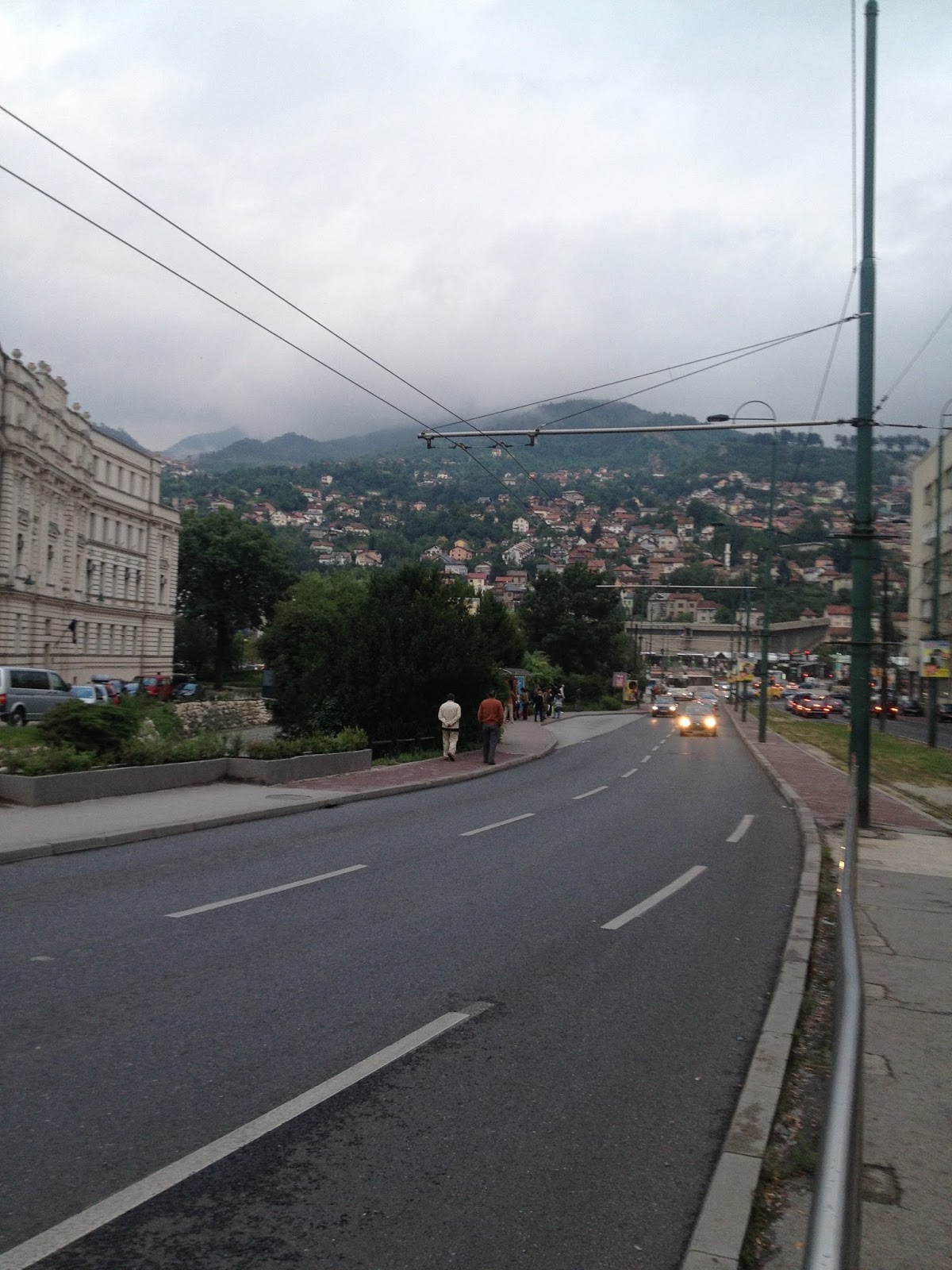
Just after the "safe" part of the street, we are now looking south to the southern hills and the Grbavica district.  Notice how close it is to the main part of town....this was held by the Bosnian Serbs.  And because they held this area, and there were so few tall buildings blocking their line of vision.....

It created the famous "Sniper Alley."  We are looking west here on Ulica Zmaja od Bosne, and on trying to move along this part of the main road, was dangerous as snipers from the South (left) could easily pick off residents trying to move East/West.  Often times residents would wait for a tank and walk behind it to provide a shield.  The building on the right is the famous Holiday Inn, where reporters were based.

The Holiday Inn and the new Bosnian Parliament Building.   If I remember right (this is what I get for waiting a few months to post) the Bosnia Serb leader had some of his military men on top of the Holiday Inn and then when Bosnians came to demonstrate and state that they wanted a united Bosnia, shots were fired and the start of the conflict between the Bosnian Serbs and the Bosniaks began.

Just south of the Sniper Alley is the Vrbanja Bridge.  Just to right (South) is the Grbavica district (Bosnian Serb held).  On this bridge a Bosnia Serb and his Bosniak girlfriend were shot trying to reach the southern side where they thought they had made a deal to be safely led away from Sarajevo.  However, the dead couple lay dead on the bridge for days and they became known as the Romeo and Juliet of Sarajevo.


A building the faced towards Grbavica.  Still bears the holes of the bullets it absorbed.

This is one of the few streets that has mature trees in Sarajevo?  Why was it not cut down for firewood during the siege?

Because just on the other side of the river, Bosnian Serbs held these apartment buildings.  No one was willing to get shot at from such close range.

So if the residents of Sarajevo were cut off from supplies, how did they get any food?  The answer lies below this house out west by the airport.

The residents dug a secret tunnel to shuttle people and food in and out.  It literally ran underneath the airport.

Out in this nondescript backyard was the lifeline of the residents under siege.


Residents of Sarajevo were bitter at the time because of the UN Arms Embargo.  What that meant was that there was no legal way for the Sarajevans to arm themselves to push back against, or even effectively hold off Bosnian Serbs, who were being helped by Serbia itself.  The residents needed to illegally import arms via this tunnel.

By 1995, the UN implemented a no fly zone over Sarajevo and then started bombing the Bosnian Serbs in the mountains above Sarajevo.  This eventually led to the Dayton Peace Accords, which effectively gave Bosnian Serbs their own autonomous region within Bosnia and a separate arm of government.  Within Sarajevo, you still see bombed out buildings from the time of the siege.