|
| The end of the Shanxi trip was a visit to the newly founded Datong Middle School attached to Beijing Normal University. It's the equivalent in Datong of the high school in which SYA is located here in Beijing. We got a grand welcome. |
 |
| Welcoming ceremony. SYA students on the right, the students of Datong Middle School on the left. |
At this point, I have to stop and get down some thoughts about my frustrations with our students, and thereby point out the differences (or my perceived differences) in teaching American versus Chinese students. Students in China wear a school uniform. Therefore, our students are required to wear a school uniform. You can see from the photo that the American students flaunt that rule and don't follow this rule. Because we don't have any consequences, they simply don't follow our request and the rule that we have. This is something that has become more of an issue for me in my teaching. Everything I ask of students must be come with consequence if there isn't compliance or fulfillment. Was it always this way where American students didn't comply with rules simply because they were rules? Or was I just always a rule follower and didn't have the "think outside the box mindset" to see that there were alternatives other than doing what I was told? Students in China simply do what they are told. I'm not saying that they like the rules, but they will follow them. Another example of this on this trip. We visited the school for the afternoon of three straight days. Our students don't find visit school fun, in fact it is a burden. (I would think that the whole idea of coming to China is to SEE and EXPERIENCE China and that going to a school to see your peers in action and interacting with them is itself why you came....but well, that's beyond the scope of this post) Because students don't want to come, and because there isn't a consequence for absence, we had, on the second of the three days, 14 of 60 students claim they were sick. That's basically 25% of the students sick...on the same day? 8 of the students were from 4 boyfriend/girlfriend couples? Suspicious in my book, but more importantly, it's an affront to our trip coordinator and his hard work as well as an unwillingness to show up to something that is asked of them. The immediate benefit is nil, it's a pain to go to boring Chinese class and get accosted by Chinese kids at break, but sometimes, you make a connection as many of our students did. My conclusion is that our students don't want to do things they don't want to do and don't have the discipline to see that they should go, because maybe there will be some benefit in a way that they don't perceive before they go.
So the question I ask myself is would I rather teach these unruly, sometimes ungrateful and unappreciative, but often times funny, creative and independent thinking Americans? Or would I teach the what I think to be the quieter, obedient and rule following Chinese students. From the tone of my previous paragraph, you would think the latter, but I think I would rather have the pains and frustrations of American students (maybe it's the known "evil" versus the unknown "evil"). The joy and humor that the American students bring can provide great highs and fantastic interactions. I guess it's taking the lumps of the bad with the really great moments of good.
However, as I get older and students change as society changes....get back to me.
 |
| Afternoon activities |
 |
| Dinner in the dining hall! |
 |
| Now THIS was a "I'm in China Experience." One afternoon, we were spectators in the finals of a singing contest. 10 finalists sang songs in English in an "American Idol" competition. |
 |
| One of the contestants singing "Right Here Waiting For You" Other selections, "God is a Girl" (sung twice), "Nothing is Going to Change my Love for You", "I Surrender", "Almost Over", "My Heart Will Go On" and the winning girl won by choosing the right song "Wanna Be" by the Spice Girls. She won because our students danced and sung along in the audience. |
 |
| Now after the awards ceremony, we were treated to THIS performance by a male student. He is a great dancer and everyone in the room registered that he has gender identity issues, or at least is feminine in his demeanor. Some of our students got to know him and reported to me that he clearly identifies with being a female, but is also quite popular and one of the smartest kids in the their class. I asked around to see if kids would make fun of him/her and they reported that just like in the US, they might make fun of him behind his back, but they wouldn't in public. Mostly because he/she is a well-liked kid. I think that is the truth about any student/person who is out of the mainstream, as long as they are someone likeable, there isn't a problem. Or I simply might be too optimistic. |
 |
| I wondered if teacher's would stop any bullying of this kid. Well, they were here in front filming the student on their phones! |
 |
| Our travel coordinator and resident hipster, Li Laoshi throwing down with his awesome singing. |
 |
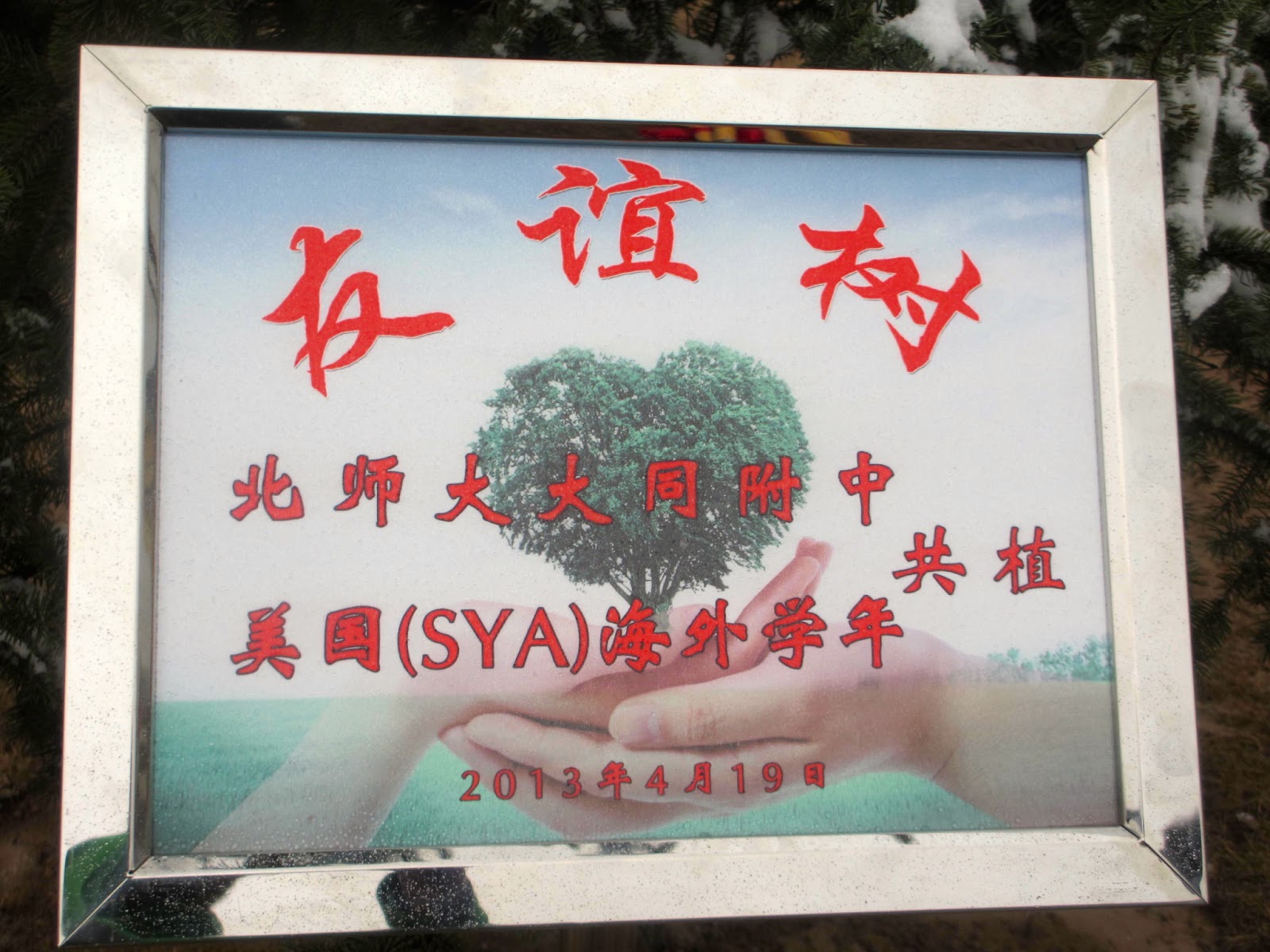
| On the final day, the school planted a tree in honor of our visit. |
 |
| Time to say good-bye. |
 |
| Datong is another Chinese city with a wall, or in this case a partially restored wall. |
 |
| Looking inside the walls..... |
 |
| .....and outside the walls. |
 |
| And yes, this man is dancing with a drill. Unfortunately, he had not yet pulled up his shirt and set it on top of his Buddha Belly in the half on half off style, Chinese men LOVE to show off when the temperatures rise! |