Tuesday, November 29, 2011

Udinese-Roma (2-0)

After the drive through the mountains and the Soca River valley, we headed west, back into Italy (and again being able understand the language, it's amazing how sharp the language boundary is) to attend the Udinese vs. Roma game.  This was the reason for the entire trip!


Walking through Udine Centro, I saw the team bus and had to take a picture of it.
Stadio Friuli.  I always get asked "why Udinese?"  I think it's the underdog streak in me.  Udine is a town of 100,000 people, about double the size of Viterbo, but has managed to be a team that has been in Serie A since 1995.  It is the little team that has held its own against the big boys, Inter, AC Milan, Roma, etc.
And I, like a lot of people, thing Antonio Di Natale is AWESOME.  By the way, I now own his jersey.  He's been loyal to this club and city.  A year ago, Juventus (who I think of as the evil Yankees of Serie A) tried to buy Di Natale, but he refused the trade!

We sat one section over from the "ultras."  No knives or fights!
"SALUTI CAPOLISTA!!"  A win over Roma brought Udinese to the lead of Serie A.  I have to reveal that, Udinese played the first game of the weekend, so its lead was temporary.
The end of game salute to the fans from the players!

Monday, November 28, 2011

The Julian Alps and the Soca River Valley

Driving northwest out of Bled, you get to the way Northwestern Corner of Slovenia (and thereby the former corner of Yugoslavia), turn south at Kranska Gora to head into the Julian Alps over the Vrsic Pass.  Note, the day was cloudy and overcast until we made the turn.  Perfect clear skies for the rest of the trip, perfect for high mountain views.
But first, a detour to see the Planica Ski Hill, which is the 2nd largest ski hill in the world.  Many, many world record ski jumps have occurred at this location.  Someday, I'm going to learn to ski jump!
The road up to Vrsic Pass from north to south has 50 hairpin turns, 24 up, and 26 down.  The turns are paved with cobblestones for better traction.
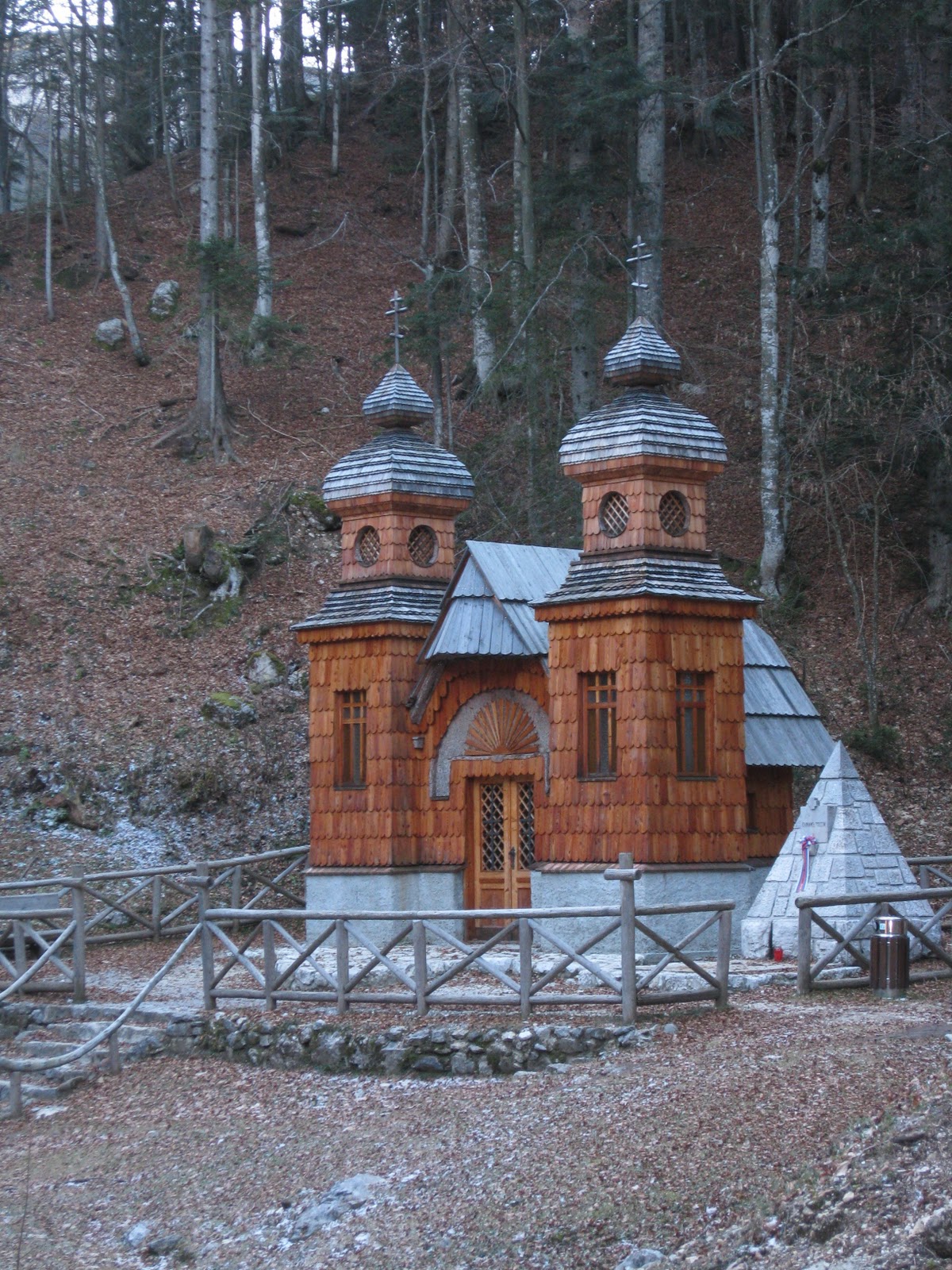
The Vrsic Pass is called the "Ruska Ceska" or "Russian Road" as it was built in 1915 by Russian Prisoners of War held by the Austro-Hungarians during WWI.  The A-H's needed this road built to supply their troops on the other side of the pass who were battling the Italians.  More on this to come.  Many Russian workers died in avalanches and so the survivors built this in honor of their brethren.
Although this isn't the actual pass (it's to right of this shot), this is was what the Russians faced.
Picnic time at Vrsic Pass....in the SUN!!
As you descend from the pass, you are heading south into the Trenta Valley.  Here is a view back towards Vrsic Pass.
The valley makes a sharp turn to the west.....(note this being late fall/early winter the sun was low, sometimes not even getting to the valley floor.)
.....and we are at the eastern end of the Soca River Valley.  This valley is historic for being the location of the front (known as the Isonzo Front) in Italian during WWI. 
Between 1915 and 1917, the Italians and the Austro-Hungarians fought 12 battles in this valley and in these mountains.  Why you ask?  Turns out the Italians were miffed that that A-H's were granted Italian speaking areas in an earlier treaty.  After initially declaring neutrality in WWI, the Italians declared war on A-H to get those lands back.....and more.
That IS the color of the Soca River.  It's got a marbley white quality it to it.
A gratuitous picture of me.


Throughout the valley, you see cemeteries and graves of soldiers who died on the Soca front.
This cemetery, back on the other side of the valley, is one of the most poignant war cemeteries I've ever visited.


Moving south down the Soca River, at a critical narrow juncture, stands Fort Kluze.  Those openings are pointed at.....

.....this vista.  Or to shoot at any attackers coming up the valley.

Across from the Fort, are rungs to aid in a quick getaway?
In the town of Kobarid (Slovenian) or Caporetto (Italian) there is a museum which explains the wars of the Isonzo Front.  As you can see, a great deal of fighting was done in the mountains, and in most cases, the A-H were in position and the Italians were attacking hill.  11 Battles of the Isonzo Front...it was a war of attrition.
But it was the 12th Battle of the Isonzo Front, also known as the Battle of Caporetto that changed EVERYTHING.  The A-H's called in the Germans for help.  In a surprise attack, the Germans used poison gas and "blitzkrieg" fighting methods to push the Italians (who still relied on top down command decision making) back 25km in one day.  It was the worst day in Italian Military history.  This here is the very moving Italian memorial to the Battle of Caporetto.  One thing D and I noticed is that the names of the deceased are in alphabetical order.  We joked that it had to be the work of the Slovenians!!!

The Isonzo Front was the site of Hemingway's "A Farewell to Arms", which I read in preparation for this trip.  It's awesome to think that Hemingway drove these same roads and saw these same views...although in much different circumstances.

Sunday, November 27, 2011

Thanksgiving 2011 -- Slovenia

Teaching at an American school, we get the traditional 4 day Thanksgiving holiday break.  4 days?  Where to go.  I was poking around the Internet back in early October and was checking out the Serie A schedule and saw that Udinese (my team, as you all know) was playing at home, in Udine, on Friday the 25th of November.  Usually, Serie A games are on Sunday so this was a special game......and then I find out that Udinese is playing Roma and it's official, I'm headed to Udinese for the game.  If you look at a map, you'll see Udine is right on the border with Slovenia and that becomes the destination for this Thanksgiving day break.  First stop, Lake Bled.

Hawaii?  No, Slovenia.  This is "Slap Savica" or "Savica Waterfall" at the far western end of Lake Bohinj, a more remote and less commercial lake in Northwestern Slovenia.
Thanksgiving day itself was overcast and cloudy, but the lake was calm and we see the reflection of a mountain in Lake Bohinj.

Lake Bled is about 3.5 miles around in circumference, but it has cliff faces jutting directly up from the surface of the lake and has a castle looming over it.

Here, on the foggy first day, is a view of Lake Bled from the castle.  Right there in the lake is a small island, with a church which brings the charm factor "over the top" according the Rick Steves' guide.  I have to agree.
The next day, in the morning, the sun was trying to peek through and we went along the path near the island. The stairs of the island come right down to the shoreline.  This island is known for being the wedding capital of Slovenia and it is tradition for the groom to carry the bride up the steps.
No motorized boats are allowed on Lake Bled, so getting to the island is only by these "pletna" boats, which are rowed by families who pass down the boats (and the plans for the boats) from generation to generation.
No motorized boats, you say?  Well, turns out that Lake Bled is the rowing capital of Slovenia.  Lake Bled, because it is sheltered by the mountains to the west has little wind and is ideal for rowing.  The world championships of rowing have been held on the lake four times, most recently in 2011!  
The area has produced numerous world and Olympic medalists in rowing!
Turns out the place I found to stay was right above the training center.
I used, for the first time, the website AirBnB, to find this one bedroom apartment.  It was PERFECT, quaint, and cost 40 dollars a night.  If all AirBnB locations are of this quality, I'm sold!
For those who remember him, Josip Broz, aka Tito, was the legendary figure who held together the six distinct and separate republics in one unified Yugoslavia up until the country started to break up in 1990.  The first country to gain its independence was Slovenia, the northern most of the six republics.  Here is Tito's villa on Lake Bled.
Taking a stroll along the ground of the villa.

In a ballroom on the second floor of the villa there is a huge mural extolling Tito and the Yugoslavia.  Up in the left corner, the attack by the Nazi's on Belgrade and in the center Tito rallying the people of this region (Yugoslavia) to bind together as a country.
Defeating the enemy...the Nazi's
The ideal of Yugoslavia, the farmer and the worker in the shadow of an industrial factory being led by a woman with a child on her shoulders carrying the flag of Yugoslavia!
Ala Tito, sitting and enjoying the view from the terrace with the Island of Lake Bled in the background!