Sunday, February 28, 2010

Cappella Palatina

So, after the church at Monreale, we retained the same guides (talk, talk, talk......) for the rest of the afternoon and visited the Cappella Palatina (the chapel in the Norman Royal Palace), the Duomo of Palermo and a fourth church. Everything in the afternoon was done by earpiece and wireless microphone making any comprehension impossible. So, while I still had any motivation, I purchased a little English guidebook for the Cappella Palatina to give me some understanding of what I was looking at. But after that, I didn't even keep the earpiece in and I exercised my option as a teacher to simply walk away and not pay attention. I was the envy of the students.
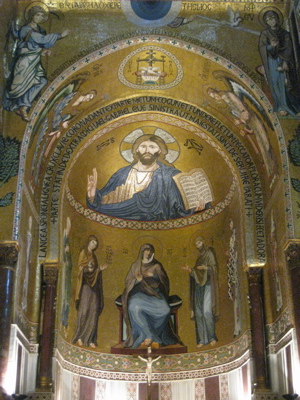


The apse of the Cappella Palatina. Similar iconography, material, etc. as the apse at Monreale.


At the back of the nave is a throne area.


Porphyry, or purple marble, only comes from Egypt so having it installed in one's church was a sign of power and wealth. It's beautiful and has such a sensuous feeling to the touch.


The whole chapel is filled with biblical scenes and for someone like me who never went to Bible school, the stories are lost on me.


A frieze of mosaic palms run the perimeter of the chapel.


The coolest thing of the chapel, and the photo just doesn't capture it, are the "muquarnas" of the nave ceiling. These are wooden stalagtite type things that form a 3-D fractal pattern.


The duomo of Palermo and at this point, I checked out.


This is a famous fountain that we walked by from one church to another. Can't say much about it.


We had some free time at the end of the day and I found this sign which is a monument to all those who have tried to fight the mafia. Only in Sicily...


Leaving Sicily on a boat from Tunisia, you can see why Palermo is called "The Golden Shell" as it is enclosed by a circle of mountains. Our 8 hour trip from Palermo to Tunis was rocked by heavy winds and strong waves. Seasickness was the theme.

The "Mash-Up" Church of Monreale

Moving from the Greeks of the 5th Century BC, we now have an interlude to visit the great buildings of Norman Sicily of the 12th Century AD. The Normans, the French descendants of the Vikings, took advantage of the power vacuum in the Mediterranean at the time and established themselves in Sicily. The Norman kings built this church about 12 km south of central Palermo high in the hills. I have to admit that on this day, our guides were completely incomprehensible too me as they spoke for 30 minutes at a time in rapid Italian. I got about 10% of it and the rest I just dozed off. The study of Byzantine art means lots of mosaics, flat figures and scenes of Jesus and whatever rules co-mingling to indicate church and state head being one and the same. I think that's the gist, but I might be wrong as I kind of zoned out during this part of Art History class.


You walk into Monreale and are taken by the sight of Christ as pantokrator, ruler and judge of Heaven and Earth. This is clearly a Byzantine form of art, but it is place in an semi-dome apse at the end of the church. Traditional Byzantine churches have hemispherical domes at the center of the building. This is also a step away from the Greek and Roman worlds where temples were built to worship in a monastic way, whereas this is the glorification of monarchs.


The layout of the church, is a large cross, with a long nave and apse along the longitudinal axis. In addition, the nave as corridors to the side of the central seating area.


The church at Monreale, unlike many churches of the time that were created and finished over long periods of time, was erected and decorated in a short span of time, about a decade. The Norman kings, used Islamic workers who put their own touches on the churches with their amazing geometric mosaics.


So, we have a Christian church, with Byzantine art, church/state overtones and iconography, built and decorated with Islamic details. Mash-up.


Upon closer inspection, you can see the amount of labor done by the the workers. These tilings aren't perfect in the least. No mechanized stone cutting here. Each piece was cut and placed by hand.


Being a Geometry teacher, the mosaics and tilings were most interesting to me.


I want to say that each and everyone of them was different, but I didn't actually look closely enough. The general effect was what we call in Art History class, "spallodire", or "WOW."

Saturday, February 27, 2010

Selinunte and Segesta

Continuing our tour of Greek sites, we left southern Sicily and proceeded to the western Sicilian province of Trapani to visit Selinunte and Segesta.


Most of the temples here (there were many) are now piles of rubble. Only the Temple of Hera has been restored, yet it too is again starting to crumble.


Each temple, or in most cases, piles of the original temple itself are identified by a letter. This is Temple F.


There was a large discussion amongst teachers as to whether it is appropriate/disrepectful of our students to climb on the ruins. The legal reality is that climbing is not allowed but the rangers turn a blind eye. In addition, there are no barriers to prevent any person from getting to the temples themselves.


My opinion was that our students wouldn't be damaging the temples and their approach to getting on them was not to try and move them (no way they could) nor as a sign of superiority, but one of experiencing the scale and immensity of these temples.


The last word was made by the director and he said no, however, some of the daughters of the teachers did manage to run around in the temple ruins.


The temple at Segesta.


Only when you climb up to it, do you realize how amazingly well sited this temple was. Nature....everywhere.


In Segesta, which was one of the highlights of the trip for me, was a climb up to an amazingly well preserved and sited Greek theater. Here's the entrance....


.....and here's the theater itself and the amazing panorama.


Throughout the trip, each student and faculty member was asked to perform 10-15 lines from Vergil's Aeneid. We were asked to explain our lines, read it in Latin and then do an interpretive reading of the English translation. In most places, the lines referred to actions at that site or descriptions of it.


Here's what the readers in Segesta were looking at. I have to admit that I came into this year thinking that "classical" studies were a fairy tale, but now, having seen the sites that are in the canon, I'm turning into a true believer.

Friday, February 26, 2010

Valle dei Templi

The "Valley of Temples", a misnomer since the temples are actually on a long ridge paralleling the sea, are located on the southern coast of Sicily outside the modern city of Agrigento. On a beautiful early Spring day we toured the temples and had an afternoon to simply enjoy the sun sites.


From this vantage point at about the center of the ridge line, we're looking eastward towards the Temple of Juno.


The Temple of Juno


The Temple of Juno is in the Doric style and dated to about 450BC.


This is a "mandola" tree, or an almond tree.


The best preserved, and most photographed is the Temple of Conordia (Temple of Peace) sited at the center of the group of temples.


Because it was turned into a church in the 6th century AD, it was partially rebuilt and thereby the best preserved.


The modern town of Agrigento is less that a kilometer from the Valle dei Templi.


Here's the view from Agrigento.


The Temple of Heracles located on the western edge of the Valle dei Templi. These remains are probably the oldest of the temples as seen by the basic flat round capitals.


In the archeological museum, we have a reconstruction of a "stone zeus" that was used as one of the columns of the Temple of Zeus, which is no longer standing. For scale, there is a grand piano at the base of Zeus.


Here's a cork model of what the Temple of Zeus is thought to have looked like. Put this together with the picture above and you can imagine how large the Temple of Zeus must have been.


This cross at the base of the ridge (note the temples on the ridge on the right) was the location of the late Pope John Paul II's visit in 1992. Of note, when he spoke here, it was the first time a Pope had ever uttered the word "Mafia" as he was here right after a high profile murder of a Sicilian judge.

The "Venus of Morgantina"


The "Venus of Morgantina" currently at the Getty Museum in Los Angeles.


This is the story of repatriation, which is defined as the act of restoring or returning a person or thing back to its country of birth or origin. The statue above is at the heart of a controversy/dispute between two countries and has some major implications in the world of art and the market for art.

Museums around the world spend millions of dollars acquiring priceless and historically significant pieces of art and subsequently put them on display both to make money by drawing in customers, but also to serve an educational component in exposing those visitors to the historical significance of those items. However, there are times when museums get burned by buying a forged piece or another way they can run into trouble is when the provenance, the paper trail of sales and title to each piece, is either forged or doesn't exist to begin with.

This takes us to the Venus shown above. The Getty purchased it for $18 million from a London art dealer, who claimed to have acquired it from a Sicilian art dealer who provided provenance of private ownership reaching back to 1939. That paperwork turned out to be false. Italian police and culture ministers now claim that the Venus was stolen, from the site known as Morgantina, by tomb raiders and want it returned to Italy.

Much research and study has gone into whether or not the Venus could have come from Morgantina. The Getty has sponsored soil and rock analysis, yet a definitive answer as to where the Venus originated back in the 5th century BC can not be pinpointed.

In the town of Aidone, the nearest town to the Morgantina excavation site, we visited the museum that wants to house the Venus and it is making a loud claim to that right.


The archeological museum of Aidone, Province of Enna, Region of Sicily, Country of Italy.


Now, let me tell you something about the town of Aidone. It's small. The Province of Enna, in which Aidone lies, has the HIGHEST reported rate of poverty in the country of Italy. There are few services. It's hard to get to. Anecdote. All 70 of us on the trip were free to find lunch in the town and the best most of us could do was go to a supermarket and get sandwiches from the small counter. The country of Italy certain has all legal claim to the Venus, but would it best be served by being placed in this small town where few people will travel to see it? And if those intrepid art lovers did come would they find services or be able to find the museum at all? Where would the Venus be best for the public versus the pride and sense of importance it would bring to the people of this region are probably competing issues. These all are questions that are yet answered.

So, where does the situation stand at the moment? The Getty Museum has agreed to return the Venus, along with about 50 other items, back to Italy. This agreement was made back in 2007 and all but the Venus were returned. The Venus had already been scheduled for shows through 2010 and will be repatriated back to Italy by the end of this year. Where it will be in Italy is yet to be determined. Might it go back to Aidone? Or might it end up somewhere in Rome?

It's a fascinating question, one of intrigue, history and economics all wrapped up into one complex question, all over a statue of a goddess that was most likely made around 400 BC.


After our visit to the museum in Aidone, we went down the road to the Morgantina site itself. As you can see, it was socked in the fog.


It was eerie to be walking in such a historically significant site. It was hard to find our way around and easy to get lost.


The inhabitants of this side had a working village with public markets (the picture above was a macellum, meat slaughterhouse/market) and here a theater.


On one of the row of benches, was an inscription dedicated to Dionysius, the god of wine, fun and theater!

Thursday, February 25, 2010

Agira and Leonforte

Stop 2 on the Sicily/Tunisia expedition was a visit to the central Sicilian towns of Agira and Leonforte. The Ancient History teacher here has an Uncle who is the principal of a school in the town of Agira and an arrangement was made to have our school visit their school. A stop of few tourist agendas, Agira and Leonforte are Sicilian hill towns at their most authentic.


Approaching the town of Agira. Our visit was a huge deal as evidenced by the fact that we stopped at a gas station to be officially welcomed by a provincial official.


The liceo our school visited, named after Martin Luther King of all people.


Here is our school director being interviewed for local television.


Students were divided into groups of 6 or 7 and led on a tour of town and school by students of the liceo. The Italian girl in purple in the center of the photo I challenged to an Italian/English face off. I lost after three rounds as I didn't correctly conjugate a verb and said the equivalent in Italian "We is Americans." Some of the students are supposed to Facebook friend me.


Men of Agira...for my Italian Men on Benches series.


At the end of the tour of town, we climbed to this lookout for a magnificent view of Mount Etna.


The two groups of kids before heading down for an amazing potluck lunch of homemade food served up the the mothers of the students.


After lunch we moved ourselves over to Leonforte. This town, mayor is looking to the left in the center, rolled out the RED CARPET for our visit. We were given a thorough tour that lasted five hours. We started with a church and then a beloved city fountain.


This is a belltower with tilings that show an Islamic influence. One of the major themes of our journey is how the island of Sicily, at the center of the Mediterranean has been ruled influenced by many different cultures.


Stop 3 was this fountain.


It has 24 spouts.


Legend has it that if you drink from all of them you will be blessed with good luck.


I thought this was just a cool looking picture. At this point in the day, the students heard "cappucini" so they were excited to go and get coffee. Little did they know they were actually on their way to ANOTHER church, of the Cappucini order. The name of the coffee is named for the color of the robes of the order, which match the drink itself.


Here is the mayor of the town speaking about on of his towns proud sites. Our last stop was a visit to the newly built athletic complex. After a long good and heartfelt goodbye by residents and students, we drove off into the night and onto our next Sicilian adventure.