Monday, March 29, 2010

Venice -- A Day in the Life

After the school trip to Florence ended……SPRING BREAK. The original plan was the my friends Keith and Paul were going to rendezvous with me in Venice for a few days before I headed off for the balance of my 10 day vacation. Alas, due to unfortunate circumstances, Keith wasn’t able to fly over and Paul decided to meet other friends in London. So, it was off to Venice by myself. Part of me loves traveling by myself, but there is a small part of me that is starting to get a bit tired of it and wished I had someone to come along and share the experience. Did I really just write those words for publication? Not sure of the implications of those feelings (well, they are obvious) but what I actually do to rectify the situation is the issue. Ok, I digress.

So, three days in Venice were wonderful. The weather was great for two and a half of them. This first Venice post is all my pictures of daily life in the city of canals. I am always fascinated by how people function in cities. Where are the grocery stores? How does the transportation system work? What about schools for children? Here’s some of what Venice looks like from the local perspective., well as local as I can be being a tourist and all.


The famous canals of Venice.


Even though the city is overrun by tourists, off the beaten track, you can find deserted streets which look like any street in any Italian town.


Need produce? Go to the nearest boat.


Italy is holding regional elections, here’s a poster for the Communist Party.


In days gone by, the Venetians would get their water by placing cisterns to catch the rainwater. Today, these are filled in but you’ll find the external remnants of them all over the place.


As in every major city, local schools are having difficulties. Communities even in Venice are rallying to have their local schools remain open.


Just like everywhere, garbage is placed in large dumpsters around town, but they are then….
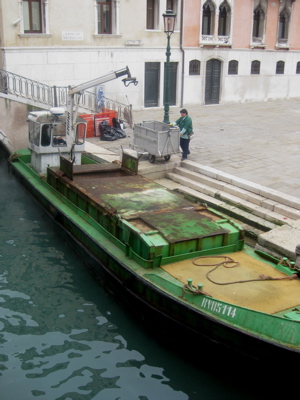


…hauled to the nearest garbage boat.


No delivery trucks here, but delivery boats.


Alas, in Venice, the vaporettos (boats that operate as the city buses) are delayed because of fog.


Two houses side by side with these house numbers. As you may imagine, you find places in Venice by landmark, not address.


Living on the ground floor has its hazards. When the water rises, called aqua alta, here's one attempt at keeping the water out.


Here comes your mail.

Sunday, March 28, 2010

Florence 2010 (Accademia & Archeological Museum)

Yes, the school and I went to the famous Uffizi Galleries (Uffizi means "offices" in Italian) but since they don't let you take pictures AND I was busy on an Art History scavenger hunt, nothing about that visit posted here.

Total non sequitur here, but you know how you hate those people who have insider connections and because of that get to do things that you never thought you could do. Well, it happened to me and I am totally grateful for it. The director of our program has a friend who works IN the Accademia of Florence. Yeah, the Accademia that houses Michelangelo's famous "David". He calls her and she meets us out in the street and lets us in the back door, thereby skipping the entire line. In addition, because the Accademia is primarily a conservatory, it has an entire section on musical instruments. This friend works in that part of the Accademia and gave us a performance on a replica one of the earliest pianoforte ever made. TOTALLY INSIDER.....I wonder how often I am missing out of treatment like this.


Although this looks like a harpsichord, our insider guide is actually playing a pianoforte. A harpsichord picks at the strings, thereby only one volume of sound can be made. The pianoforte has a "knocker" (can't think of the word) that hits the string, thereby the player can vary the volume of the sound. Pianoforte literally means "softloud."


Here's one of the "prisoner" statues which shows the process of carving out a statue from a chunk of marble.


Ahh, David. This is actually the copy of the real one. This copy stands in the Piazza outside the Uffizi.


This 5th Century BCE Kouros shows how far man's ability, Michelangelo's in particular, had come in 1,000 years.


The famous Ponte Vecchio over the Arno River.


Going back to the Etruscans, here's the Chimera of Arezzo, one of the most significant bronzes of that era.


We studied both the Chimera and this man, Aule Metele, the Orator. Once again, it's so cool to see in person those pieces we studied in class.


Sunset over the Arno. Goodbye Florence...until next time.

Saturday, March 27, 2010

Florence 2010 (Santa Croce & Laurentian Library)


The Basilica San Croce was built in the 14th century and because is burial site of great Italians it is nicknamed the "Temple of Italian Glories". Interesting note, the facade was designed by a Jewish architect (note he worked in the Star of David) hoping to be buried inside the church itself. Alas, he didn't make as he was buried under the porch.


The interior of the church is known for its many chapels. Here's one done by Donatello. The only think I remember about it is that he was using local materials therefore the coloring is bland.


The tomb of Michelangelo


And here's Galileo's tomb


And the tomb of composer Rossini


"Crucifix" is by Cimabue and is significant because he is a bridge between the Byzantine flat style and the naturalism to come in the Renaissance. You'll notice the flecks of paint that are missing, this damage was due to the 1966 flood which ruined many great pieces of art.


Basilica San Lorenzo which houses the Medici family chapel, sacristies by both Brunelleschi and Michelangelo and the Laurentian Library. The facade was never finished.


Here is the burial site of one of the Medici family members.


The Medici's commissioned Michelangelo to build a library in the cloister. Here is the entrance to the reading room.


The Medici family had the library built to show that they had moved from simply being merchants to a family of intellectual heft. The library housed the private books of the family.


A closeup of the ceiling. Wondering if Michelangelo had something for longhorn bulls?


Books from Latin, Greek and other languages are incredibly well preserved.


Many of the books were medicine/health related.

Florence 2010 (Above Florence)

Ok, no, I didn't get in a plane and actually fly above Florence, but on two occasions, I went into the hills around the city. The first, to the north, to the town of Fiesole. The second, a hike up to San Miniato on the south side of the Arno.


Here I am standing at the marker of the site where Leonardo conned one of his friends to try out his flying machine.


According to Google Translator (my Italian is getting better every day but this one I had to use "the evil tool") the plaque says "Take the first flight off the big bird above his Ceceri Great filling the universe with awe filling all writings with its fame and glory to the eternal place where he was born."


Here's what they saw from their attempt to fly.


I'll cite the pamphlet describing the facade of the basilica, "The white and green marble dating from the 11th/13th centuries is typical of the Romanesque style in Tuscany. The idea of strict geometry evoke the perfection of God. Standing over the top is the bronze eagle of the Calimala Art guild, the corporation of wood merchants that for centuries kept patronage of the church adeptly COMBINING FAITH AND PROFIT, as was typical of the Middle Ages."


Ahh, another great view of the Duomo and Florence.

Friday, March 26, 2010

Florence 2010 (Around The Duomo)

I forgot to state in my previous post that the stops in Pienza and San Gimignano were the first day of the fourth of final trip of the school year. This last trip takes us those two stops in Tuscany and then finishes with two and a half days in Florence. We come to Florence last as this is about the time Art History is studying the Renaissance. I had how much there was to see in Florence and it's all packed into such a compact small area. There was no way to try and see everything in this one trip so I'll surely be going back on my own as well as coming back with the school next Spring.


The Chiesa Degli Innocenti (1419-1434) was built by the great Florentine architect Brunelleschi. This church was part of a hospital and its significance was that it might be the worlds first orphanage.


Babies could be "dropped off" at this turnstile and the child would be taken care of by the church.


The Duomo of Florence, Brunelleschi's architectural masterpiece. The Museo dell' Duomo has an exhibit about how Brunelleschi solved the architectural problems of constructing what is still the world's largest brick dome. Alas, I never had the chance to go into either the Duomo itself of its Museo. Next time.


The Florence Baptistry is just to the West of the Duomo and is known for its North, South and East doors.


Here are the north doors. In a competition sponsored by the wool merchants guild, 21 year old Ghiberti beat out the other finalist Brunelleschi to win the commission.


There are 28 quadrafoil panels each depicting a scenes from the New Testament. What is of note here is the return to classicism.


Ghiberti, after finishing the north doors, was given the commission for the East doors. The east doors are particularly significant because they open up on the to Duomo. The idea being once you were baptized, you left through East doors and stepped both physically and metaphorically into the the world of the church.


Michelangelo dubbed these 10 panes the "Gates of Paradise" and the name has stuck. The artistic significance of these panels is Ghiberti's introduction and mastery of perspective. The arches show us that there is a world beyond and behind what we see. Because of this, Ghiberti was able to tell more than one story per panel.


Florence was a economically wealthy because of the Medici family (banking) but also because of the guilds (wool, fur, etc) who also used their money to commission art. The Orsanmichele (the tall building in the middle between all the modern stores) was originally a grain market and storage facility.


The niches on the side of the building were assigned to different guilds who commissioned artists to install statues within. Here is four martyrs (can't you just imagine them in conversation!) created by Nanni di Banco and commissioned by the wood and stone workers guild.


St. Mark by Donatello commissioned by the linen weavers)


The Duomo dominates the psyche of Florence. It seems like you can always see it and it always takes your breath away. More to come...