Monday, February 08, 2010

Malta

It's been mighty cold here in Central Italy so I decided I wanted some sun. Therefore, I went online a few weeks ago and found the cheapest flight I could find to a place somewhere south of Rome and I landed in Malta. The country of Malta consists of two inhabited islands and one small one in between them that isn't populated. The country is 90 km south of Sicily and is at the crossroads between East-West and North-South. Being one of the few islands in the Mediterranean, it has been fought over for centuries. It was a former colony of England (they drive on the left) and is now part of the European Union. The language? Maltese which is some mash-up of Italian and ????. I could understand some stuff, but some of it just sounded outright strange.


The capital is Valletta, which is a peninsula around which are two harbors. Here's the opening to the main industrial harbor.


The harbor is fortified on all sides and the bastions now ceremonial, but they do fire the cannons once a day.


The old city of Valletta reminds me of San Francisco with the hilly streets at right angles to each other and the bay windows overhanging.


Once you leave the old city of Valletta, much of the main island of Malta looks like Miami Beach, with the high rises along the beach. In the distance is St. Julian's Bay, the home of a casino (right there at the point) and all the posh hotels and clubs. Yes, I did walk around to verify the "Eurotrash club" scene, but I did not participate.


Although known for it's seafood, I ate meat pies for most every meal. You can get them for under a Euro and are TASTY!


Where do the old buses from around the world end up? MALTA. The buses are converted to diesel, repainted and put into service here. The country has set up a fantastic bus system and you can get everywhere on the bus.


Here's the inside of a bus, with the old benches and cord along the ceiling to ring the bell. I did notice that if you sat in the back and had to get out fast, the only exit being at the front is a potential fire hazard. Probably why these buses have been retired from service in other parts of the world.


Based on reading a blog recommended by Julie F., I got myself to the more rural island of Gozo. The island is charming and beautiful. This is the citadel in the middle of the island. In the 1500's because the island was so vulnerable to attack, all residents of the island were required to sleep in the citadel each evening.


In Homer's Odyssey, Odysseus was held in a cave by Calypso. That island is supposedly Gozo, and here's her beach.


I'm not sure where the actual cave is supposed to be, but I'll just say it's somewhere down there.


Ta' Pinu Basilica and Gordan Lighthouse near the town of Gharb on the NW coast of Gozo.


At the far western end of Gozo is the beautiful Azure Window.


The rock in the foreground is called....Fungus Rock. Why? No idea.


The morning before I flew back to Italy, I attended a reenactment of a 1500's parade that demonstrated a fort's readiness. These were the spearmen.


I gather this is a Maltese Falcon. However, it was purely decorative as it did nothing but sit on the man's hand the entire time.


The general waving goodbye to the troops and his approval the the troops were battle ready.


Would I go back to Malta? Probably not. It seems like a wonderful place to live, Gozo I'm speaking of, but to visit, really not much to do. Once was enough.

Sunday, February 07, 2010

Museo Della Civita Romana & EUR

If it's Friday, there's a good chance the school is on a day trip. This past Friday, I elected to join the group that went to the Museum of Roman Civilization. For those of you who have kids who ever come to Rome, this is the museum for you. EVERYTHING is a copy of the real pieces so you can touch all you want. The guards don't even bat and eye if you start fondling something. My only warning to you is that the museum is FREEZING COLD. There is a reason why, but you'll have to wait until later in the posting to find out.


The museum is great because it has great "cheesy" models like this one which tells the story of Julius Caesar's capture of the Gallic town of Alesia. Caesar was a great military general and his claim to the throne was expansion of the empire, Gaul (modern day France) was the feather in his cap.


Story goes that the town was inside the walls of the city. Caesar had the time to build these structures to eventually get his men into the city and take it. Students in one of the advanced Latin classes here knew the story from their readings. Makes me want to take Latin so I can learn these things myself.


The Museum shows how Roman life worked. Here is how they guaranteed themselves clean water. Water came in on the left and then worked its want into the bottom two chambers. As water increased the water came into the top right chamber clean because all the silt and dirt settled out into the bottom left chamber.


Augustus (you all know how I feel about him) in his classic portraiture. My advisee Steve C. is playing cupid as you see is also at the feet of Augustus.


Here's the model of what is hypothesized to be Augustus' tomb.


Here is what's left of it in Rome. It sits next to the Ara Pacis, but it's closed off.


Constantine, the emperor who changed the course of religious history by declaring the Roman Empire to be Christian.


One tool the Romans used to make right angles. If the Romans could do anything it was to build great structures.


Economics was an issue in Roman times as well. Diocletian sought to curb inflation by setting price ceilings, which as we know in a capitalist society only makes things worse. Free markets, baby!


Trajan's column, which still stands in Piazza Venezia in Rome has a continuous frieze wrapping around it telling the story of Trajan's two successful wars in Dacia, modern day Romania.


Mussolini had plaster casts of the entire column (the casts number around 125 or so) made and they are housed in the museum. Here is the cast somewhere in the middle which shows the story of Trajan and his men setting off into the Adriatic to fight the second Dacian War.


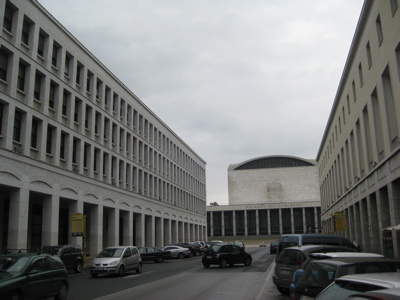
The Museum is in an area of Rome known as EUR, or "Esposizione Universale Roma". This area, southwest of historic central Rome was until the 1930's a flat plain that was claimed by Mussolini and the Facist regime as the area they would build upon to showcase, in 1942, their 20 years of rule. As we all know, that didn't come to be as WWII started and Mussolini had other issues to deal with. This is what modern Italy MIGHT have looked like without the fall of the Facists. Everything is BIG and grand, wide streets and built with a nod to great architecture of the Roman Empire. It's BIG, but it doesn't have much "heart". It leaves the viewer cold both emotionally and physically as I mentioned about the museum. The rooms of the museum are 20 feet high and huge, there is no way to efficiently heat them, therefore they are left only with space heaters, which don't do the trick.


Here's a church the facists built, but it seems to miss the mark.


The inside, not inviting.


This building is "pinnacle" of EUR facist architecture. It is known as the "square colosseum". The inscription says "A people of poets of artists of heros of saints or thinkers of scientists of navigators of explorers."


Monday, February 01, 2010

Castel Sant'Angelo aka Hadrian's Mausoleum


In Rome, history is EVERYWHERE. Right on the banks of the Tiber is this huge round building, which was originally built in the 2nd century CE by Hadrian as his family's mausoleum. Today, it is a museum and in the foreground here is the beautiful pedestrian only bridge which leads right to the entrance.


The original structure was only the lower cylindrical portion that has a rough exterior. That original structure was covered in marble and had a garden on top.


Roman emperors were buried in Hadrian's tomb for the next century up through Caracalla in 217 CE. In the 5th century it was converted into a military fortress. In the 14th century, the pope's of the nearby Vatican (a mere half kilometer away) built a passageway directly to the structure in which to take refuge when Rome was under siege. Throughout all the changes in function, the upper additions were added on as well as the defense wall. During the time when central Italy was officially called the Papal States, the building was used as a prison. In 1901 it was decommissioned and today it is a tourist site, museum and the location of perhaps the most stunning view of Rome.


If you remember the movie "Roman Holiday" the dance by the river and the subsequent tussle between Joe Bradley and Princess Ann was filmed right where the decrepit barge currently is moored.


The view to the Southeast. You'll see the Pantheon's dome and the building that looks like a wedding cake is the building that commemorates Victor Emmanuale II, the first president of Italy.


Looking west, St. Peter's in the distance on the left and somewhere underneath the ground is the secret passageway connecting the Vatican to Castel Sant'Angelo.


The angel of Sant'Angelo. From this point is where the heroine of "Tosca" commits suicide.


Looking Southwest, the Tiber and the Jiniculum hill.


Here's our man Hadrian. He was one of the great leaders of Rome. An internationalist, he spent most of his reign traveling throughout the Empire (with his male companion while his wife remained in Rome) taking stock of what was in the Empire. Hadrian did not expand the Empire.

Sunday, January 31, 2010

Ara Pacis Augustae

In 44 BCE, Julius Caesar was murdered and for thirteen years the Roman world was subject to civil war. In 31 BCE, Octavian, Caesar's grandnephew and adopted son emerged victorious and from 27 BCE to 14 CE, he was the ruler of Rome. Octavian is better known to all of us as Augustus. Augustus was not only a great military general but an outstanding administrator. He set up institutions and built public infrastructure that had lasting positive influence for the next few centuries. He did such a good job and left such a legacy that even his bumbling descendants of the next century couldn't undo the good that he did. The Roman Senate conferred upon Augustus the title of "princeps" the first of all citizens and he occupied all key positions. His rule was the time in the Roman world known as PAX AUGUSTA, the era of Roman peace.


Here he is, Augustus. I have to say, I kind of have a crush on him.


In 13 BCE the Ara Pacis Augustae (Altar of Augustan Peace) was started. The monument celebrates important moments in his life and as a symbol of the prosperity Augustus brought due to the fact that the Roman world was in a time of peace.


The original location of the Ara Pacis was on the open campus/plain north of the Pantheon. It was built on next to a sundial. Along the Tiber in the far distance, Augustus built his tomb. The original location of the Ara Pacis was in the Tiber's flood plain and over the course of centuries was buried by mud. In 1938, it was decreed that the Ara Pacis' pieces were to be brought together and reconstructed. The modern site is along the river to the left of Augustus' tomb.


In 2006, a modern building was built to house the Ara Pacis. It was built by Richard Meier and is not popular. Here is the water in front which is brilliant in the fact that it prevents the wall from being tagged.


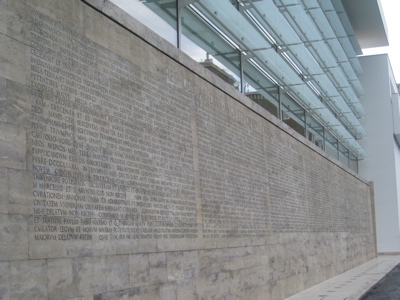
On the side of the Meier building that faces Augustus' tomb is his "Res Gestae" or the instructions he left to his descendants on his philosophy and ideas for maintaining and building the Roman world.


Here is the Julio Claudian family tree. Augustus' third wife Livia is rumored to have made sure that all of Augustus' children and grandchildren by his previous marriage were dead by the time Augustus passed away. Thereby when it was time to determine a successor, her son by a previous marriage, was named the leader of Rome.


On a separate note, notice here how Marcus Agrippa, son-in-law of Augustus by a early marriage, died in 12 BCE.


Marcus Agrippa's son Agrippa Postumus was born in 12 BCE after the of this father. Not sure if the concept of "posthumous" was named for this event or if the boy was named after the concept.


Inside the Ara Pacis is the altar at which sacrifices were made.


The most famous panel shows a woman with two babies and a bounty of fruit. This is most likely a depiction of the great benefits that Augustan peace has brought to the people of the Roman world.


Along the sides of the Ara Pacis are these long processions which are thought to be a glimpse of the inaugural procession in 13 BCE.


Here is the procession on the South side from back to front. It's charming in the fact that children are included acting like children, not like little adults. They are tugging at their parents clothes and talking to each other when they should be behaving themselves. Augustus probably had children included as a sign that having children was noble due to his worry of a declining birthrate.


The hooded figure on the left is most likely Marcus Agrippa.


Here we are getting closer to the front of the royal family but I neglected to actually photograph Augustus himself.