Thursday, December 10, 2009

Louisiana Museum of Art

Of course, I had to ask why a museum of modern art in Denmark is named Louisiana. The answer is of course because the original owner of the land had three wives all named....Louise. Seriously, how does that happen?

The Louisiana Museum of Art is two train stops south of Helsingor and sits on the same channel as Kronborg Slot. The buildings, are connected by glass corridors and link up to form a large circular shape. I didn't realize that one underground corridor brought me to a part of the museum that I had been to earlier. That surprise was in and of itself worth a visit to the museum. I'm usually pretty skeptical of modern art, but the exhibition they had during my visit was engaging. I laughed a number of times and that was matched by the instances where I just went, "well, damn!"


Here's one of the glass corridors that connects the buildings.


Looking across the from one end of the museum to the other. The channel that separates Denmark from Sweden is to the right.


Literally, this was the first piece of art I saw.


Open up and it's......a fully functioning bathroom. I got a feeling that I was going to enjoy my visit.


So an artist stripped a prototype hydrogen car built by BMW and stripped it of it's outer shell. Then he replaced the it with "ice" racing stripes. To see it, you have to go into a "refrigerator".


The steering wheel.


This artist turned 1,000 microphones and attached them as one large "cloud" or microphones, turning what usually amplifies one voice for many to become the speaker itself.


This artist took a number of people and subjected them to something that made them fearful. He then took the essence of their sweat and managed to turn that smell into a scratch and sniff wall. Seriously, people's fear sweat smells different from person to person, I had my nose to the wall.


Another exhibit was one of a Danish photographer who had spent time traveling throughout the United States (mostly in the south and midwest) taking photos of obese people, poverty, KKK members, blacks, all the underbelly of American life. The exhibit was PACKED with Danes. They were enthralled, obviously it was new to them. For me, yawn. I was more into the people watching.


The Louisiana Museum itself is known for its environmentally sensitive architecture. Another exhibit was about the future of green cities. Here we have the model of a completely planned city somewhere in the Middle East. I was too tired at this point to be "educated" so I glossed over this part of the museum.


This piece is made of self-necrosing material.
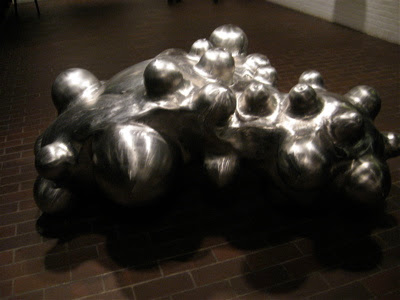


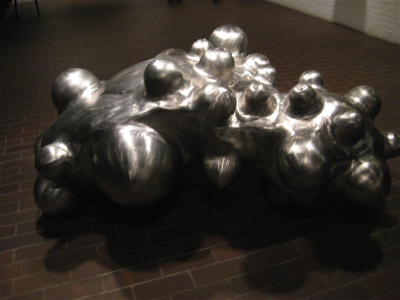
The museum did have its share of this kind of art which I usually am indifferent to, but because of my enjoyment of the rest of the museum, I could walk by and not curse it.

Wednesday, December 09, 2009

Kronborg Slot at Helsingor (aka Elsinore)

The magic of Facebook put me back in touch with a friend that I first met back in the summer of 1987 at a summer program the two of us attended in Seattle. Rory B. now lives in Copenhagen, Denmark with her Danish partner, Anne. Many thanks for their hospitality and their comfortable couch.

My first stop while in Denmark about 40 kilometers (I'm European now, so I'll go metric) north of Copenhagen in the town of Helsingor, was the Kronborg Slot, or more widely known as Elsinore, Hamlet's Castle. The castle is a great representative of a renaissance castle as it was built by King Fredrick II in 1585. Kronborg sits on a point that juts out into the channel that separates Denmark from Sweden and was important both militarily and economically.

A fire burned most of the castle in 1629, but it was rebuilt by Fredrick's son King Christian IV. From the late 1700's through the 1920's Kronborg Slot was a military installation, housing soldiers and used for administration. In the 1930's it was restored to its former state and is now used by the Danish royalty on special occasions as well as the annual reenactment of Shakespeare's Hamlet.


My hosts Anne and Rory


A view of Kronborg Slot (from Wikipedia)


The moat, I show this picture because it's documents the only time I saw sunshine in my three and a half days in Denmark.


The entrance into Kronborg Slot


The 4 km wide Oresund which separates Denmark from Sweden.


There is no bridge across the channel, so boats still ply the waters. The channel is active with both cargo ships traveling North/South and passenger ships East/West.


One tower of Kronborg Slot is a lighthouse.


Cannons were used to fire upon enemy ships, although today they are used for ceremonial reasons.


Kronborg Slot is built in a square with a large courtyard in the center.


The King would sit in this room and look out the window and watch for ships to pay respect to him by lowering their flags. If they didn't the paid a fine. In addition, for many years the King of Denmark would charge a tax to any ship coming into Danish waters. This was abolished once and for all in the mid-1800's.


A typical feast of up to 15 courses. Note no silverware.


Many tapestries hang throughout the castle. They had a practical purpose, as they helped retain heat in each room. But they also serve as propoganda as each King had his own tapestry created and upon which was written his achievements.


This is the great hall of Kronborg Slot.


Every trip has to have some comment about food. Throughout Denmark, there are sausage carts where you can purchase tasty franks. The best one I had was one that was wrapped in bacon!


Apple Dumplings and Glogg, a mulled wine with raisins.


Glogg is made and kept warm in huge copper vats.

Tuesday, December 08, 2009

Classical and Hellenistic Sculpture


The Greek woman Niobe had the hubris to claim that her children were more beautiful than the gods, so Artemis and Apollo killed her children in retaliation. This sculpture, THE ORIGINAL Greek marble is housed at Palazzo Massimo alle Terme (PMaT). It is from the classical period as evidenced by the lack of facial expression. There is no pathos.


Here, from the rear, we see one of Niobe's daughters trying to remove the arrow from her back. Another characteristic of this being classical is the lack of eroticism.


In addition, the fact that the body is one of a male (note the abs and the Madonna-like cone breasts) indicate that Greeks sculptors of the 5th century had not yet focused on nor mastered the naked female body, as they had with the male.


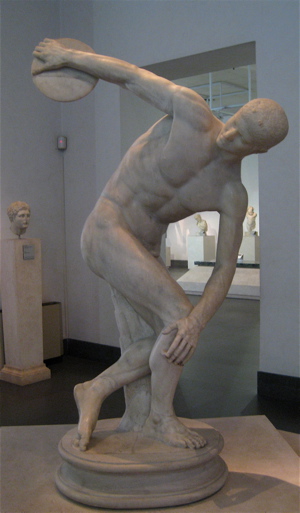
Speaking of perfected male bodies, here we have a copy of Myron's "Discobolos (PMaT). It is again classical.


There is tension in the body, it's coiled like a spring. Notice how the two arms form two separate arcs to form a bow. However, the face is expressionless, the norm for Greek sculpture of the classical period.


The original bronze has been lost, most likely melted down for other use. The marble copies, sometimes altered to the sculptors design or needs, could not support the weight so you see here, from the rear, the strut that supports the discus thrower himself.


Here in the PMaT they have recreated the fresoced rooms of Roman villas. This garden scene would have given the diner a sense of eating and being outside with the nature.


This is a copy of the Aphrodite of Knidos located at the Palazzo Altemps (PAtp) which is the museum which displays the art collection of the Ludovisi family. The Aphrodite of Knidos is a transition piece from the classical to Hellenistic as the woman is starting to be more female like in form, but she's teasing us, but not yet fully erotic.


This is just COOL!


Here is a copy of Lysippos' Herakles performing the first of his twelve tasks at Patp. Lysippos was Alexander the Great's personal sculptor and changed the canon of sculpture with the head being 1/8 of the body instead of 1/7.


This is a bronze statue of the "defeated boxer" at PMaT. The Hellenistic age was one of chaos in Greece and it was witnessed by the fact that subjects were no longer young perfect males, but old defeated men, such as the one we see here. He's got a smashed up mouth, cauliflower ears and blood dripping from his forehead. We no longer have the noble warrior!


The seated boxer is huge, he's seated would stand over seven feet tall if upright. On left, is Spencer F. or Pennsylvania.


Here's a 2nd Century AD copy of a 4th Century BC Hellenistic piece by Skopas. Being seated generally meant defeat, which was something the Greeks were experiencing in the 4th Century BC.


The Crouching Venus is the epitome of the Hellenistic woman. In a time of chaos and famine, she is curvy, a sign of fertility and erotic all in one. Sculptors have mastered the female form.


Here's the Gallic (because of the long shaggy hair) chieftain heroically killing himself after ending the life of his wife because he doesn't want either to them to be prisoners of war. (PAtp)


What's fascinating is the the Roman's are showing their enemies in a heroic light. The face, although covered by the arm in the photo is full of expression and pain, a change from the classical period.


Drama is the hallmark of the Hellenistic sculpture.


With "Tivoli General" (PMaT) we move ahead into sculpture of the Roman republic. The parts don't match. We have a realistic face of an older general attached to a young mans body, a Greek reference. Notice also the breastplate (again holding up the marble copy) is a signal to the audience of the generals rank. It's a sign of the Roman use of art as political propaganda that we will see a great deal of in the near future.

Saturday, November 28, 2009

Villa Farnese in Caprarola

This 16th century palace built by Cardinal Alessandro Farnese (future Pope Paul III) was originally conceived as a fortified castle. His grandson decided to turn it into a country estate for the family. The palazzo was bequeathed to the Duke of Parma and subsequently to the King of Spain while that country ruled the Italian Peninsula. Now it is open to the public and one of the holdings of the Italian government.


The front of the Villa Farnese in Caprarola a 30 minute bus ride from Viterbo. It is built in the shape of a pentagon!


A sundial on the front wall of the palazzo. The students and I were unable to decipher how it really worked.


The courtyard is not built in a pentagonal shape, but in a circle.


Here in the guard's room (the modern day entrance), there is a fresco of the town of Caprarola. As you can see the palazzo is built at the top of town.


This is the room that has the has the five arched windows of the front facade. It is known as the Hercules Room. The highlight is the fountain on the West wall.


The second (main floor) is divided into two five room "apartment", one the winter and the other the summer. Here is the Aurora (bedroom) room of the summer apartment. This is the fresco on the ceiling one would wake up to each morning. You can see "night" coming in on a dark chariot and "light" coming in on a chariot with white horses.


The palazzo has extensive gardens. Here's a view of the garden house with the moon rising as dusk settled in. You can see the day was gorgeous.


The gardens were surrounded by a group of caryatids.


Here are a couple of the more humorous ones.


I have to include this picture of the students playing foosball. We had some time before the bus came and we took over the table and played for an hour. From left Myles H. of California, Steve C. of Minnesota and Lisa A. of Pennsylvania.


The final two photos are some of my favorites from the day.