Monday, October 05, 2009

Munich -- Part 2


A half hour train ride from Munich is the town of Dachau. If that sounds familiar, it's because the town was the location of one of the major concentration camps during the Nazi reign from 1933-1945.


This plan shows what the Dachau camp looked like at its "height." The barracks where the detainees were held are closest to the and the SS homes are further back.


This map shows all the the camps and subcamps that were run by the Nazi's.


This index shows that not all concentration camps were death camps. In fact, very few were death camps. Dachau was a work camp, meaning that detainees were brought here essentially as slaves and their worked benefited the Nazi state and regime.


Auschwitz, you'll see has a "V", which indicates it was a camp where prisoners were sent to their deaths.


A prisoner could be brought to Dachau and then sent to one of many subcamps in the area. These other subcamps could be factories or for any reason and were held as few as 20 detainees.


The majority of prisoners entered the Dachau camp through this entryway.


They would see this, which means "Work makes you free."


Each and every morning and evening the prisoners would have to line up on this large area (we're seeing only half of it in this photo) to be accounted for. In 1933-35, the camp had some 10,000 prisoners, but by the mid-1940's Dachau had some 60,000 persons.


During roll call, those that incurred infractions (at the beginning for things as minor as not making their bed) would be publicly whipped on this table or one like it.


One of seven watchtowers that are along the wall of the camp.


In the twelve years of camp, only one man escaped. There was a moat on both sides of the barbed wire fence.


Here is the remains of one of the shower rooms. This room is now in the museum.


In the years after the camp was liberated, the barracks were torn down. Here is the footprint of the 28 barracks. In 1965, a committee of Dachau survivors had two of the barracks rebuilt,


Inside the barracks, one can see what the living conditions were like.


Can you imagine what these would have been like with some 2,000 people sharing them?


One of the many sculptures that serve memory of the atrocities that happened on this site.


Those who were brought here were not just Jews. Everyone who was brought there was given a sign to wear on their clothing indicating why there were at Dachau. In the beginning, most were political prisoners and they were given red triangles. Criminals were given a color, Jews, were given the star of David, but if they were also here for another reason, their star had two colors. Gypsies and Jehovah's Witnesses (because they refused to take an oath to the Nazi's) were here as well. Homosexuals were given pink triangles, which is the origin of the pink triangle of the gay rights movement.


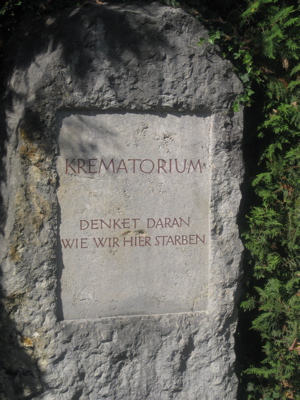
Although not a death camp, there was a crematorium on site.


The crematorium was used for those who passed away at Dachau. But there were times when it was used simply to put some detainees to death. It was not, however, used for mass killings. The SS kept records and with the discovery of mass graves, it is estimated that some 41,000 people died or were killed while at Dachau.


This was the disinfecting room. Notice the hooks for their clothes.


This is the entrance to the gassing room, although it says over the door that it's a bathing room.


The gassing room.


The ovens. In the later years, due to coal shortages, these ovens weren't used so bodies were dumped into mass graves.


On the other end of the Dachau camp, here is the housing for the SS troops and officers.


This is Roland and Henry looking sheepish as they admit that their iPhone GPS systems directed us to the wrong train station. Sometimes....


However, with every detour there is a silver lining. We saw this spray painter at work. You never seen any graffiti in Germany and here was some being created.

Sunday, October 04, 2009

Munich -- Part 1

This weeks postings are brought to you by the wonders of Facebook. My cousin Henry posted that he and a friend were making a last minute trip to Munich and Budapest around this first weekend in October. So, I plunked down my credit card at the travel agency here in Viterbo and less than 24 hours later, I was on a flight from Rome to Munich to spend the weekend. This will be the first of three posts about the weekend. Henry and his friend Roland flew in and arrived Friday morning. My flight landed at 7PM and I took the amazingly efficient and clean Munich S-Bahn to meet them as they were finishing up a day at Oktoberfest. Yes, there will be pictures and details of my participation in days to come.


The three flags that fly over Munich.


Henry and myself


The Rathaus at Marienplatz on Saturday morning


Henry and Roland, both iPhone devotees, were consistently tethered to their phones. It got us lost, but that story will be upcoming.


A typical Bavarian/German breakfast spread


The muesli was beyond words. I went back the next day for a second bowl.


We stayed in a hotel that is located in the Olympic Village, about a 10 minute U-Bahn (subway) ride from center city. Munich hosted the 1972 Summer Olympic Games.


The athletes village was converted into living units and sold as condominiums. There is plenty of commercial property as seen by this bakery.


Here's a map of where each country's athletes were housed.


Many of you older than me remember the tragedy of the murder of 13 Israeli athletes during the games. Here's the three units in which they murders happened. As you might imagine, there is a memorial and they are vacant.


The Olympic complex is, like the one in Athens, open to the public and the facilities are used.


In the past six weeks, I've been to the Olympic Stadiums in Athens, Rome and Munich. I guess this gives me a reason to go to Barcelona, Berlin and Helsinki.


The Munich Olympic Wall of Fame. Mark Spitz the Michael Phelps of his time.


Wonder where bands like Roxette go?


A typical Munich Street. I have to say that Munich is a beautiful, functional and attractive city. No wonder it is continually rated as one of the top cities in the world.


On Sunday, Henry and Roland had an 11AM flight to Budapest. My return flight to Rome left at 3PM, so I took the opportunity to walk through Munich's main park, the Englischer Garten.


As you can tell, the weather was perfect all weekend. The park is full of paths, rivers, bridges, fields and even a horseback trail.


A wooden pagoda in the heart of the park


Only in Bavaria would a Chinese restaurant also have a biergarten.


Looking back at center city Munich


Of course, the Englischer Garten has to have an English style garden


I get to the airport and as I'm in the security line, I see Henry and Roland. They missed their flight. As we were waiting, we started chatting with Justin (right) who is an architect from Hong Kong living in Genoa and working for the world famous architect Renzo Piano. I'm going to be visiting him there sometime.

Sunday, September 27, 2009

Lazio vs. Palermo (1-1 Tie)

I've never seen a live soccer game at the professional level, so why not make the first here in Italy and a Serie A (the highest and most prestigious league) to boot.There are two Serie A teams in the Rome area. There is Roma, with it's famous striker Totti and Lazio and it's most famous player, Zarate. I think there are political overtones in one's choice of which team to choose (Rome being the team of the liberal city elite and Lazio being the team to support for the suburban, more conservative set, but I'll have to confirm that). I kind of wanted to go see the game and see a car get burned or a huge set of fights of break out, you know, general hooliganism, but it was a well behaved crowd. I guess those are a thing of the past, or simply limited to Great Britain. The game itself was enthralling. Palermo scored at minute 74, and then Lazio tied it at minute 83. I found myself entertained by both the game itself and the general atmosphere.


The only bummer of the day was finding out I got RIPPED off by using a ticket broker. Face value = 15 Euro. I paid A LOT MORE.


Stadio Olympico was built in a northern neighborhood of Rome for the 1960 Summer Olympics. It has been renovated a couple times and is currently the home of both S.S. Lazio and A.C Roma. Rome is also putting in a bid to host the Summer Games again in 2020.


The mosaics from the original 1960 games are still intact.


Not sure why there is an obelisk to Mussolini at the entrance to the Stadio Olympico.


Light Blue and White are now my Calcio colors.


To enter the game, you must show your ticket and then show proof of citizenship. For most Italian's it's their National ID card, for me, my passport.


I got the cheapest ticket, which turned out to be the equivalent of the bleacher section at a baseball game. At Stadio Olympico, it's sections 47 and 49 or better known as the North Curve.


The Curva Nord is the part of the stadium that is filled to the brim with crazed fans. It is definitely the place to be.


The pitch


In Italy, ballpark food is a pork sandwich on foccacia and a seltzer water.


As I learned from reading the sports pages, Lazio plays a 4-2-4 whereas Palermo plays a 4-3-3.


If I hadn't run out of battery charge, I would have included a video/audio clip of the constant singing. I hope someday to not only understand the words but sing along.


For various safety reasons, the stands are divided up into sections that cannot be crossed. In addition, the entrances and exits are also divided by barriers as well.


The visitors from Palermo, isolated in the far corner away from Curva Nord and surrounded by security guards.