Thursday, September 03, 2009

Tinos and The Greek Wedding

One of the great benefits of my job as a teacher is watching many of my favorite students graduate and become adults. Once they graduate from college, I consider them my peers and do everything in my power to dissuade them from calling me "Mr. Chen." Some of them find this the hardest part of maintaining a friendship and I settle for being called "Chen." The reason I mention this is because the main purpose of my trip to Greece was to attend the wedding of two students who I taught back at Lville. They both graduated in 1998, the year I left, however they didn't really know each other and become a couple when both were living in London these past few years.

The father of the bride was born and raised in a small village on the Greek Island of Tinos in the Cyclades group. Tinos is a mere 6km from its more famous neighbor, Mykonos, but it has not sold out to commercialism and the party scene. It has retained its agricultural and rural flavor. It is particularly known for its marble work.

Speaking of the father of the bride, he truly is an amazing testament to the American dream. As you'll see in the pictures, his town was tiny and remote. He joins the military, is in Athens, meets a girl from New Jersey and after two weeks they are engaged. He moves to the United States not knowing any English. Learns the language, establishes himself as a successful painting contractor and earns enough to put his two kids through an expensive private school and is now throwing a wedding for his daughter in his home village. So, all of you who criticize America and its values, it still is the ultimate land of opportunity.

So here, as you all have been waiting for, pictures of my three days on Tinos.


The rocky Greek isle of Tinos


The village of Isternia (the one on the hillside) at the northern end of Tinos. This photo was taken from the boat.


Many companies run boats, I choose the slow boat. It was the right call as many of those who took the high speed hydrofoil found themselves quite seasick. Boats that sail to the Cyclades now leave from the newer port of Rafina, which cuts down the trip by two hours (my trip was four and a half) if you were to leave from the main port of Pireus.


Many of you know I have a thing for ferries (just like Dr. McDreamy from Grey's Anatomy). I had to take this picture because of the TOTAL CHAOS that is embarking and disembarking passengers and cars onto Greek boats. You would think that after all these years they would figure out how to make it more efficient, and safe.


The largest "urban" area of the island of Tinos is, Tinos Town.


The second day on the island, we were treated to a bus tour of the island. Here's a view of Tinos Town from up high on the island.


All the little villages are charming and the great thing is that there are no dead ends. You can be sure that you walk down a path and that you'll have some option at what looks to be the end of the road.


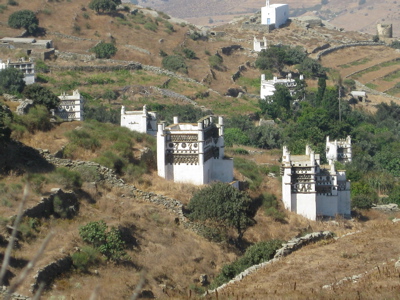
These structures are called "dovecotes." I believe that the doves fly into them and then are trapped and eventually eaten by locals. Tinos is famous for the ornate dovecotes, of which there are over 700 on the island.


The highest point on the island is called Xoburgo, which translates to "out of town." Makes sense if you go back and read the name letter by letter.


When we got to Xoburgo, it was in the clouds and windy.


Five of us make the 20 minute climb anyway. On the left, Wylie C. (the groom) and on the right Alana K. (Lville '96).


The area surrounding the town of Volax looks to be a sea of rocks. Because of this, people just incorporated the boulders into the structures of the houses.


The wedding itself took place at the church in the town of Isternia. Greek Orthodox of course.


The view of the water and the beach from the church plaza.


As a signal that the events of the evening are to commence, the bride and groom who were housed in different locations in the town started shooting off rifles. Back and forth they went and things began.


A violinist and guitar player escorted the groom to the church. In tow were all the male friends, family members and any other male who wanted to join. The bride did the same thing with females.


We all follow the couple into the church.


We stood around in the church and witnessed the ceremony. It was all in Greek.


The parents of the bride.


The priest who conducted the ceremony which took about 45 minutes.


The most important moment of the ceremony is when the wreaths are put on the heads of the couple as shown here. Then they do a dance (or just walk) around a table three times as we in the audience threw rice.


The bride's family name as inscribed in a pillar to indicate they gave money for some restoration project in a former time.


Two cool people I met at the wedding. On the left, is a woman who I found out is the manager of "The Travel Bookshop" featured in the moving "Notting Hill". On the right, Isaac, who married an Lville grad who further confirmed for me that people who go to Harvard ARE smarter than the rest of us. The quality of conversation I had with him and the insights and ability to connect things was amazing.


The groom, his older brother (who I was a housemaster for at Lville) and myself.


The reception was held in the Isternia town plaza. The entire town was invited (and many of them showed).


Greek dancing. They apparently know one step and do it in a circle, but do it for hours on end. Yes, I learned it and participated.


The requisite picture of all those associated with Lawrenceville. Do I look to be a decade older than the rest of them?


On the day I left the island, my boat was one of the last to leave and I ran into the couple and we got to chat for a half hour. It was the first and only time I got to talk with them together. I thanked them for inviting me and wished them the best of luck. And like every good Greek, I wished them that their first offspring be masculine!

Tuesday, September 01, 2009

M.C. Escher


Every once in a while, reading one of those ubiquitous tourist handouts you find pays off in a gem of an experience. I found that there was a private museum in Athens that was having a year long retrospective on the Dutch artist M.C. Escher. Let's also call Escher a mathematician because he approached art from a mathematical perspective. I am going to state that I illegally took these pictures. No flash photography (or any photography in general) is allowed so I took these sans flash. So here's a little lesson in tessellations, which we at HRS teach to the 9th graders in Honors Geometry.


We learn in Geometry that each and every quadrilateral tessellates (fills space with no gaps) because the four corners can come together to fill 360 degrees. Think of your bathroom tile. Quadrilaterals! Escher here is creating a figure that tessellates by using the technique of glide reflection.


Here he's creating a figure using rotation, meaning if he makes an indention on one side, he rotates it 90 degrees so it bulges out on the next side.


Glide Reflection


Glide Reflection again. Note how if you follow a column of dogs, going up is the glide, but the heads face different ways, that's the reflection part.


Here's a tessellation inside a circle. Here Escher also incorporates the concept of limits as the edges, meaning there is a finite perimeter, but the number of figures continues to increase the closer you get to the edge. It's a paradox.

Monday, August 31, 2009

Athens, Greece

Upon return to Athens after the trip to northern Greece, I spent two days wandering central Athens. I did all the typical tourist things, so I'm subjecting you to pictures of things you've probably seen before.


First, I had to take a picture of this as I think they missed something in translation!


Here's the changing of the guard ceremony in front of what used to be the King of Greece's palace, but is not the home of the Greek Parliament. The tufts on the tips of their shoes were to hold knives to surprise their enemies in battle.


Parthenon! To think that they built this in 9 years in the 5th century BC. It was the Venetians in the 1600's that bombed the building to it's current state.


A piece of the pediment on the eastern side (entrance because it faces the sun). I believe we're seeing Dionysius, the god of wine and celebration.


The Parthenon was built as a temple to Athena, the goddess of wisdom. The Greeks also built a second temple on the top of the Acropolis, the Temple of Poseidon, the god of the sea.


The womens entrance to The Temple of Poseidon. Note that the dimensions make it a Golden rectangle.


Remember that the Parthenon and Temple of Poseidon were the two major buildings built on the Acropolis (the rock), but that there was an entire city and major buildings down at the base of the Acropolis. Here are some of the buildings that are at "sea level".


A recreated model of what historians think the area around the Acropolis looked like.


Yanni, Live at the Acropolis (and yes, I still love Yanni), here it is. There are two major theaters on the South side of the Acropolis, this one has been restored and is used regularly by the city of Athens, just like in ancient times.


This is the 1950's reconstruction of the stoa (public gathering place) of the area called the agora (market). I wrote my last college paper in Art History about this building.


The area around the Acropolis is still a working archeological site. The new Acropolis museum is built on top of a site. Here you can see the work going on beneath the see through floor.


The top floor of the new museum is an architecturally BRILLIANT celebration of the Parthenon. They have recreated the friezes, pediments and placed them all in the correct orientation. It's amazing how the archeologists have been able to identify random small bits and place them in the right place. Many of the friezes are being restored but any panel that is in blinding white concrete is known to be outside the country of Greece. So, it's time for the BRITISH MUSEUM TO RETURN these items to their rightful owner.


In my continued exploration of Athens, but what did surprise me was the quality and cleanliness of the Athens Metro System. Many of you know that I LOVE public transportation systems and so I was proud of myself for taking a taxi only twice during my entire 8 days in the Greece. I always make an effort to ride either a bus line or a subway line to its terminus. Near the end of the Green Line's northern end, here's what I found.


The complex from the 2004 Summer Olympic Games. Here's the velodrome.


This huge facility was sitting empty. I asked the guard if it's ever used. He says that it's a training facility for athletes and that there are occasional events, but it sits there as a monument to a time gone by 5 years ago. It was quite sad to think that all the money was spent to have these facilities just sit there for so many years.


This is the warm-up pool for swimmers who competed in the 2004 games. I asked around and found out that had I not been there in August (summer break for the entire continent of Europe) I could have come back and swam. Bummer.

Sunday, August 30, 2009

Delphi and Meteora


This post begins a series on my trip to Greece. Having arrived in Italy on Monday the 17th, on Friday the 21st, being an expert (in the four days I was here) on the local trains, I returned to the Rome airport and flew to Athens. The reason for the the trip to Greece, other than to see Greece, was the wedding of two students I taught back in my New Jersey years. But those pictures will come later.

I started by signing up and joining a 2-day bus tour to Delphi and Meteora. The first you've heard of and studied. The second you might have seen but might not have heard of. The bus tour, usually I'm totally against them, but this time I just wanted to sit back and do nothing about worrying about how to get places and dealing with people who didn't speak English. I put my travel in the hands of the tour and it was two days of relaxation. Pictures of Delphi....


The Sanctuary of Athena, at the lowest elevation on the side of Mt. Parnassus, is where the visitors to the Temple of Apollo and the Oracle, as well as participants in the Pythian Games, gathered before ascending to the Temple.


This was the treasury the Athenians built upon a major victory. Like many structures here, it was destroyed. This re-creation was built by the city of Athens in the early 1900's.


The columns from the Temple of Apollo


The columns again


The Temple of Apollo


The stadium used for the games are located at the highest elevation of all Delphi structures.


Being a Geometry teacher, I'm amazed at the circular seats the Greeks were able to contruct


After the first day, I, and the three other Aussies who, like me, chose the 2-star hotel and not the more expensive option, had a great conversation about the differences between the two countries. They were fascinated by California's problems, were quick to admit that Obama was unknown because during his inauguration their country was consumed by the major fires there. Their great comment was in summary to America's problems, "well, that's what happens when you have rushed democracy." I also learned to rules of cricket and the three were kind enough to simulate a game on the dinner table using toothpicks and the salt and pepper shaker. I'm still fuzzy on some of the macro issues, such as why matches might take days, but I know that it's the ultimate insult to be called a "chukka" or without the accent, "chucker."

Day 2, pretty spectacular. The reason why you may have seen the monasteries of Meteora are that a James Bond movie has been filmed here.


The buildings are monasteries of the Eastern Greek Orthodox religion built on top of rock formations above the plain of Thessaly in NW Greece


Built between the 12th and 14th Centuries, these could only be reached by rope. In modern times, steps have been carved into the towers for most of the dozen or so monasteries. However, a couple are easily reach because a road is built and a bridge links to the building itself.


Chimneys from each "cell" in the monasteries (which actually also house nuns, but still called monasteries).


Stairs leading to the monastery shown below


Looking down on the town of Kalambaka below.


For you cat lovers, feral cats live throughout the Meteora rock formations.


Lastly, according to Wikipedia, the bank Linkin Park has an album called "Meteora.". Anyone think there might be a connection between the two?