Sunday, June 20, 2010

Luzern and Interlaken


Next stop, Luzern. This is the famous Kapelbrucke which crosses the Reuss River.


This lion carved into a stone in town has the inscription "Helvetiorum fidei ac virtuis" or "To the loyalty and bravery of the Swiss". It is dedicated to the Swiss mercenaries who in the service of Louis XVI of France, were killed during the French Revolution.


In Northern Europe, instead of domes, it's steeples with clock faces on them that indicates you've found a church. Here's the main church of Luzern.


After an afternoon in Luzern, we trekked to Interlaken, about an hour and a half away. Our hotel was way at the top of a mountain in the town of Beatenberg. This was the sunset view.


At dinner, we were treated to this impromptu concert. It was great, but it inspired my father to purchase CD's of the same genre which we listened to repeatedly in the car the rest of the trip.


The highlight of any visit to Interlaken is a ride up the tram to Jungfraujoch, a tourist/tram station located at the "Top of Europe". It's located between two mountains and is 11,332 feet above sea level.


From Interlaken, first stop Grindelwald.


From here we took the tram to Kleine Scheidigg and along the way, we passed by the famous north face of the Eiger.


Alas, the sun of the lower part of the mountain was not what we found at the top. Here's the view from Jungfraujoch.


One cool thing is the Eispalace.


This sign was totally meant for me!


I think this is a funny juxtaposition.


But then, what was this. There was a restaurant in the complex called Bollywood and tourists from the Indian subcontinent were EVERYWHERE. Turns out because it's so dangerous to film Bollywood movies in Kashmir, they film in Switzerland. Therefore, the Indians want to see the scenery and flock to this part of the world. The Swiss are simply taking the economic opportunity and running with it.


We finished off the loop by coming down on the Wengen side. I know of Wengen (and a lot of Alpine locations in Europe) from watching downhill ski racing on television.


Wengen sits on a ridge above the amazingly beautiful Lauterbrunnen Valley.


Throughout Switzerland, it seems like every sheer rock face has a waterfall coming off of it. The Lauterbrunnen Valley had what seemed like 5 or 6 total coming off both sides of the valley.


This is the Switzerland we picture in our minds. It's not fantasy, it truly exists!

Saturday, June 19, 2010

The Lakes of Northern Italy

The names all are familiar: Maggiore, Lugano and Como. After hectic Milan, Mom, Dad and I spent a couple days chilling out in this beautiful area an hour north. It's exactly what the Milanese have probably been doing for centuries. And NO, we didn't see George Clooney.


First stop, Lake Maggiore and the town of Stresa. Two of the Borromeo Islands just off the coast of Stress are Isola Bella (foreground) and Isola Pescatori (smaller off to the back left).


The Borromeo family has a summer palace on Isola Bella and it and the gardens are open to the public. Nothing makes Mom happier than visiting gardens, so this was an obvious highlight of the trip.


In 1935, Mussolini, British and French diplomats met here to sign the "Stresa Front Agreement" to try and dissuade Germany from starting WWII. It fell apart when Italy attacked Ethiopia and joined forces with Hitler.


To get to the gardens, you must go through the palace. Downstairs is this amazing grotto (a place to escape the heat) that is lined floor to ceiling with stones and marble. I post this picture for a secondary reason. You see my Dad actually reading a plaque or looking at something. Perhaps one of the few times I saw this happen on the trip.


You exit the palace and enter the amazing terrace garden and see this wall.


And peacocks!


The fragrance of the place is amazing and roses were in bloom. This picture also captures what my Dad came for. Getting my Mom and I to pose for him.


We stayed an an Inn in the town of Cadenabbia on the western shore of Lake Como. A camera is simply unable to capture the feeling, majesty, grandeur and drama of the place. So I won't even try.


Our inn, and the balcony on which we dined, had this view of town of Bellagio.


From high in the hills above Lake Como you can see how Bellagio is situated at the tip of a peninsula. That tree laden "bulge" is called the "Punta Spartivento" or Point that separates the wind.


We had amazing weather the entire time in the Lakes District. Only on the day we left, did we see clouds, but they couldn't detract from the beauty of the place.

Milan

After a day in Pisa, Mom and Dad took a quick afternoon trip through Lucca before spending a couple days in the Cinque Terre region. I visited back in November so it was nice to go back and relax again, however, pictures are posted earlier. After leaving Cinque Terre, we spent an afternoon in Genoa and then onto Milan. Many people find Milan to be disappointing. But, it's Italy's financial and industrial capital. It's not situated in a really beautiful area, it's basically flat. However, it is where economic opportunity lies in Italy. I actually engaged with Milan and found wonderful things to see. The heart of it all is the Brera district. The Vittorio Emmanuele Galleria, Duomo, Brera Gallery, of course, the high fashion district are all concentrated in this small area.


One of Milan's most famous residents was Leonardo da Vinci. The "Cenacolo" (aka The Last Supper) is painted in the refectory of a nearby Chiesa Santa Maria delle Grazie. To see it, reservations need to be made months in advance. Alas, we didn't see it.


Leonardo faces this somewhat nondescript building, but it is the famed La Scala, purported to be the best opera house in the world. Recently renovated, performances are back and I hope to return to Milan and take in the La Scala experience.


One of the famous landmarks in Milan is the Galleria Vittorio Emmanuele.


It's a four story skylighted mall (perhaps one of the first in the world). It was a wonder when constructed in the 1870's (honoring Vittorio Emmanuele the first king of the reunified Italy) because it was covered AND lighted.


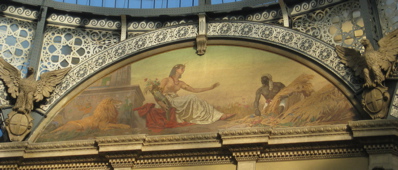
It's not only home of great shopping, but some interesting art. The two arms of the mall meet at a cross. In the four corners, near the ceiling are four mosaics that represent four of the seven continents of the world. It's a quiz, I'll post the answers at the end. Here's Number 1.


Number 2


Number 3


Number 4


There are also fun mosaics on the ground. Here's one of the symbol of the city of Torino (means little bull in Italian). The legend has it that if you spin yourself while stepping on the bulls balls, you'll have good luck. Here's Mom taking a spin.


Kitty corner from the Galleria is Milan's Duomo, and yes, if you think the facade is out of control.....it is. It's as if they were trying to please everyone at the same time, but mainly it's Gothic.


The Duomo was built to hold the entire population of Milan at the time, which was 40,000 residents. It's enormous.


There is tons of art inside, here's a statue of the martyr St. Bartolomeo, who was skinned alive. One of Leonardo's students dissected a body (in the name of science and outlawed by the church) and he carved this statue.


You can also get onto the roof of the Duomo.


You can walk amongst the spires and see the statues and sculptures that are there (there are thousands). Alas, because of a military procession that morning, the great spire walk down the axis of the Duomo was closed.


From the Duomo roof, I saw these two towers of the skyline, which I thought was a great juxtaposition of old and new.


While in Milan, I visited two museums, one the Museum of the History of the Italian Risorgimento (I've become somewhat fascinated by Italian history). It was all in Italian, but I could parse together the majority of what was being written. The other museum is the Brera Art Gallery, the front is shown here.


The Brera is actually a working art school with the second floor being a Pinocoteca (painting gallery). The building is built around a courtyard. This is a a view (from the rear, which sometimes is the better view I think) of Napoleon done by my favorite sculptor, Antonio Canova.


The Brera, being a school, also has a working restoration lab. This lab is on display and it was cool to see ALL the different machines they use. Unfortunately, there wasn't any live action when I was there.


Even though it's illegal to take pictures, I just do anyway. I get so excited (as you all probably now know) when I see a piece of art I've studied. Here is Andrea Mantegna's "Foreshortend Christ". It's a great example of the emerging mastery of different types of perspective, in this case foreshortening, defined as "the visual contraction of an object that extends back in space at an angle perpendicular to the plane of sight."


This is Piero della Francesca's "Enthroned Madonna and Saints Adored by Federico da Montefeltro". It shows Piero's interest and mastery of light and reflected light. He is amazing at making each figure a separate entity and distinct from the background and from the figures around them.


Il Bacio, by Hayez.


Raphael's "Marriage of the Virgin". Done by Raphael when he was 20 years old. The soft light, almost syrupy in its quality. But the awesome thing is that he uses one point perspective and that point is the sky through the open door. He's also referencing other Renaissance artists, especially Brunelleschi's centrally planned domed arcade.


The answers to the mosaics are 1) Africa 2) North America 3) Europe and 4) Asia