Friday, August 13, 2004
Wonders of the Northwest
As I travelled along the northern edge of our country, I have had the opportunity to reacquaint myself with my beloved Seattle Mariners. They SUCK this season and since I paid attention to them closely back in May/June their roster has completely changed. During my travels across North Dakota and Montana, the Mariners are playing their cross plains rivals, the Minnesota Twins. Therefore each night, I turn on the tv in Dickinson (aligned with the Twins) or Butte (rooting for the Mariners) and watch the game. The Mariners won both nights.
On Wednesday the 11th, I left North Dakota and trekked across eastern Montana. There is nothing more boring that having to drive across eastern Montana. There is nothing to comment on except the great meal I had in Billings. My friend Dean, a travelling salesman, covers Montana, so I called him and asked him where to eat in Billings. Q Cuisine, again like in Fargo, had amazing hip decor (like you'd find in SF or NYC) and it's sirloin with truffle sauce was excellent. I had a second wind after dinner and drove the three hours and spent the night in Butte.
Butte is, perhaps, the most economically depressed of all the Montana towns. It has a long mining history and is still reeling from some of the pollution caused by it.

Looking down into the Butte valley

Mining equipment right in the heart of Butte
Fifteen miles outside of Butte, stands the world famous Anaconda mine. This mine was active until 1980 and has the largest open pit mine in the world. The mine is known for its landmark tower, in which the Washington Monument can easily fit into.

The tower at Anaconda
After driving through scenic western Montana (not to be confused in anyway with eastern Montana), I drove through the 70 miles of the panhandle of Idaho and entered into my home state of Washington. Washington, like Montana, has a flat arid eastern portion and a mountainous, greener western portion.
The palouse of eastern Washington State
The agricultural productivity of eastern Washington is based on the amazing Grand Coulee Dam. The word coulee comes from French and is defined as "a deep gulch or ravine with sloping sides, often dry in the summer".
In 1933, FDR, signed a piece of legislation that began construction of this great gravity earthen dam to be built in the north central part of Washington state on the mighty Columbia river. It was to provide flood control, irrigation to the farmers and hydroelectic power. In 1942, it was put into service. Here is a great historical overview of the Grand Coulee Dam. It is still the largest hydroelectic dam in the United States and number 3 in the world.
The Grand Coulee Dam, a mile long
A view of the Grand Coulee Dam from the rear
The water in the river behind the dam stretches for 150 miles and is named after Franklin Delano Roosevelt.
The 32nd President of the United States
Roosevelt Lake
For those of you who want to see eccentric America, here's something I saw as I was driving through the town of Electric City, WA. Yup, that's its name.
Windmill Garden
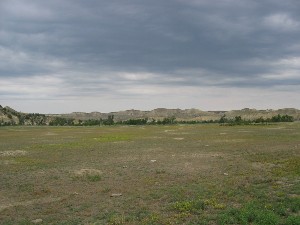
Lastly, as I drove out of the area, here's a parting shot of the coulee region of eastern Washington.
Shiprock
It is now time for a week with Mom and Dad...
On Wednesday the 11th, I left North Dakota and trekked across eastern Montana. There is nothing more boring that having to drive across eastern Montana. There is nothing to comment on except the great meal I had in Billings. My friend Dean, a travelling salesman, covers Montana, so I called him and asked him where to eat in Billings. Q Cuisine, again like in Fargo, had amazing hip decor (like you'd find in SF or NYC) and it's sirloin with truffle sauce was excellent. I had a second wind after dinner and drove the three hours and spent the night in Butte.
Butte is, perhaps, the most economically depressed of all the Montana towns. It has a long mining history and is still reeling from some of the pollution caused by it.
Fifteen miles outside of Butte, stands the world famous Anaconda mine. This mine was active until 1980 and has the largest open pit mine in the world. The mine is known for its landmark tower, in which the Washington Monument can easily fit into.
After driving through scenic western Montana (not to be confused in anyway with eastern Montana), I drove through the 70 miles of the panhandle of Idaho and entered into my home state of Washington. Washington, like Montana, has a flat arid eastern portion and a mountainous, greener western portion.
The agricultural productivity of eastern Washington is based on the amazing Grand Coulee Dam. The word coulee comes from French and is defined as "a deep gulch or ravine with sloping sides, often dry in the summer".
In 1933, FDR, signed a piece of legislation that began construction of this great gravity earthen dam to be built in the north central part of Washington state on the mighty Columbia river. It was to provide flood control, irrigation to the farmers and hydroelectic power. In 1942, it was put into service. Here is a great historical overview of the Grand Coulee Dam. It is still the largest hydroelectic dam in the United States and number 3 in the world.
The water in the river behind the dam stretches for 150 miles and is named after Franklin Delano Roosevelt.
For those of you who want to see eccentric America, here's something I saw as I was driving through the town of Electric City, WA. Yup, that's its name.
Lastly, as I drove out of the area, here's a parting shot of the coulee region of eastern Washington.
It is now time for a week with Mom and Dad...
Thursday, August 12, 2004
24 Hours of North Dakota
After leaving the Twin Cities on Tuesday morning, it was a three hour drive to the northwest on I-94 to reach the Red River, which serves as the border between the town of Moorhead, MN and the metropolis of Fargo, ND. I pulled off I-94 and toured around downtown Fargo. I found a surprisingly hip looking restaurant on the ground floor of the Hotel Donaldson. I had a surprisingly good burger.
My home away from home in North Dakota
It is 350 miles across the length of the state of North Dakota and I cruised along for an entire afternoon (listening to The Bourne Legacy) until I reached Dickinson, ND which lies approximately 70 miles east of the North Dakota/Montana border.
Beautiful amber waves of grain
About 10 miles west of Dickinson, lies a road called The Enchanted Highway. Along this 30 mile stretch of road, residents have constructed huge sculptures. Here are two that I saw:
Flying Gulls
Jumping Deer
These are HUGE sculptures. I was so sick of driving at that point that I now regret not driving down the 30 miles to see the other four sculptures.
After a good night's sleep, I headed west to see tour the Theodore Roosevelt National Park.
Theodore Roosevelt National Park
When Roosevelt was in his early 20's, a NYC guy, he spent a couple summers here in Western North Dakota hunting and living. He actually started up a business here as well. Over the course of his lifetime, he saw the bison that he hunted become nearly extinct. He saw that the place he loved slowly change and it was this that instilled in him the sense of resource conservation that lead Roosevelt to establish our National Park system. This area of the North Dakota Badlands was set aside as a reserve in 1946 and eventually was turned into a National Park in 1978. Here is a little of what Roosevelt saw:
Roosevelt's beloved bison
Prairie dogs
A thriving praire dog metropolis
Most people travel THROUGH North Dakota. Even though I didn't spend a great deal of time here, I did experience a bit of the amazing sense of space that draws and keeps people here. To give you a sense of how wide open it is, the entire state has 630,000 residents. San Francisco, the city, has 760,000 residents in its 49 square miles.
It is 350 miles across the length of the state of North Dakota and I cruised along for an entire afternoon (listening to The Bourne Legacy) until I reached Dickinson, ND which lies approximately 70 miles east of the North Dakota/Montana border.
About 10 miles west of Dickinson, lies a road called The Enchanted Highway. Along this 30 mile stretch of road, residents have constructed huge sculptures. Here are two that I saw:
These are HUGE sculptures. I was so sick of driving at that point that I now regret not driving down the 30 miles to see the other four sculptures.
After a good night's sleep, I headed west to see tour the Theodore Roosevelt National Park.
When Roosevelt was in his early 20's, a NYC guy, he spent a couple summers here in Western North Dakota hunting and living. He actually started up a business here as well. Over the course of his lifetime, he saw the bison that he hunted become nearly extinct. He saw that the place he loved slowly change and it was this that instilled in him the sense of resource conservation that lead Roosevelt to establish our National Park system. This area of the North Dakota Badlands was set aside as a reserve in 1946 and eventually was turned into a National Park in 1978. Here is a little of what Roosevelt saw:
Most people travel THROUGH North Dakota. Even though I didn't spend a great deal of time here, I did experience a bit of the amazing sense of space that draws and keeps people here. To give you a sense of how wide open it is, the entire state has 630,000 residents. San Francisco, the city, has 760,000 residents in its 49 square miles.
Further proof that I know people everywhere
Sometime during the month of June, before I left on this great journey, I got an email from a friend of mine from my Cornell years. I knew her then as Carrie R., but since I saw her last (1994), she has gotten married (husband Gerry) and is now the mother of two kids (Teddy and Emily). Carrie attended her 10-year Cornell reunion this past June and in the process went online to look up the emails of people that she could remember and boom, I popped up.
We traded emails back in June and I threatened her with the possibility of me travelling through the Twin Cities on my journey. Everything came together and Monday night, I pulled into the suburban town of Burnsville, MN and had dinner with Carrie and her family.
Now, you have to realize that both Carrie and her husband Gerry are both big time members of Math Club. Carrie obtained her M.S in Math and another in Education from the University of Minnesota. Gerry earned a PHD in Math from Minnesota as well. Carrie taught high school math for six years, took a year off to be a mother and is now returning to the classroom at a community college this fall. Gerry is a professor of Math at a local college as well.
A shout out to the N. family for being so generous and kind with food and lodging.
Me and Carrie N. (formerly R.)
We traded emails back in June and I threatened her with the possibility of me travelling through the Twin Cities on my journey. Everything came together and Monday night, I pulled into the suburban town of Burnsville, MN and had dinner with Carrie and her family.
Now, you have to realize that both Carrie and her husband Gerry are both big time members of Math Club. Carrie obtained her M.S in Math and another in Education from the University of Minnesota. Gerry earned a PHD in Math from Minnesota as well. Carrie taught high school math for six years, took a year off to be a mother and is now returning to the classroom at a community college this fall. Gerry is a professor of Math at a local college as well.
A shout out to the N. family for being so generous and kind with food and lodging.
Monday, August 09, 2004
Getting Stuck
One problem I have in my life that continues to haunt me is my inability to put down a book that I am not interested in and just give up on it. I always make myself slog through the book even if I am completely bored by it. I think a compromise might just be to put the book I am having a hard time with aside, read something else, and then come back to the book causing me problems. Alas, in an ideal world, I would have the ability to do this, but I can't so don't even suggest it.
The book that I have been stuck reading is called Fugitive Pieces. It was recommended to be by Nils S., a member of my bookclub, with whom I usually agree with on books we like. This time, however, Nils and I are going to have to agree to disagree.
Last week, I FINALLY put the book away and went to the bookstore for something new. I picked up two new books, the first is called A Home at the End of the World written by Michael Cunningham, who also wrote The Hours. This book has also been made into a movie starring Colin Farrell, Robin Wright Penn and Sissy Spacek. How different an experience it is to read when one is engrossed in the book and is interested in the characters and the plot. I finished this book in three days and then promptly went to go see the movie. The movie had some different plot changes from the book, but it was otherwise true to Cunningham's novel. I encourage you all to read or see the movie.
The second book I purchased (and am not currently devouring) was Devil in the White City which is about the construction and planning of the 1893 World Columbian Exposition (World's Fair) and the tragedy of there being a man who systematically was murdering young single women during the time the fair was being held. Again, I am enjoying the fact that I am enjoying the book.
So, I need to admit to myself earlier that if I don't like a book, to simply put it down. I have been stuck trying to read Fugitive Pieces since the last week of June. Ugh.
Minnesota
I arrived in Minneapolis on Sunday night August 9th. I spent the morning running errands and visiting the Minneapolis Sculpture Garden. It is a wonderfully peaceful park on the edge of downtown Minneapolis where there are sculptures to look at and ponder. Here are some of the ones I particularly liked.
Ordovician Pore
This one didn't have a name in the program so I'm going to call it "Lattice Scooper"
Prophecy of the Ancients
Walking Man
This last one is the signature piece of the Minneapolis Sculpture Garden, the piece that most often photographed and the identity of the garden.
Spoonbridge and Cherry
This last one is the signature piece of the Minneapolis Sculpture Garden, the piece that most often photographed and the identity of the garden.
My candidate for the tackeiest place in America
After three glorious weeks in Chicago, I packed up the car and began my journey across the northern tier of the United States with my destination being Seattle to see my family. From there, I will return to San Francisco on the 19th of August. Leaving Chicago, I drove through northern Illinois and then up through central and western Wisconsin. This mirrored my journey to Madison a couple weeks ago. About 40 miles north of Madison on I-90/94 lies Wisconsin Dells, Wisconsin. It sounded absolutely lovely (Dells sounding quite tranquil) and there were many signs along the way advertising Boat trips along the Dells. So when I got there, I pulled off the interstate, filled up my gas and then went to go find the Dells. Here's what I found as I drove down the main thoroughfare of town...
A horrifically crowded and tourist trappy Main Street
This is not unexpected in summer destination spots. Think the New Jersey boardwalk and it's t-shirt shops and weird attractions. But it got even more weirder....
This building houses an attraction called "Top Secrets"
This trojan horse stood at the entrance of the BIG CHIEF MT. OLYMPUS GO KART facility. Go karting appears to be quite populars in the Dells as I saw at least three go kart establishments
But it appears that the MOST popular activity in the Dells is
Water slide parks
Along the three mile main drag, I must have seen at least seven or eight water slide parks. Each and every one of them had lines that stretched quite long. I only caught a glimpse of the Dells themselves. It did appear to be pretty and I really did want to take the boat ride, but I just didn't have the energy to try and fight through all the tourists. I know I am nominating Wisconsin Dells for tackiest place in America, and I know that my pictures might not convey the entire tacky experience. I hope it, however, gives you a glimpse of what I saw and got away from as soon as I could.
This is not unexpected in summer destination spots. Think the New Jersey boardwalk and it's t-shirt shops and weird attractions. But it got even more weirder....
But it appears that the MOST popular activity in the Dells is
Along the three mile main drag, I must have seen at least seven or eight water slide parks. Each and every one of them had lines that stretched quite long. I only caught a glimpse of the Dells themselves. It did appear to be pretty and I really did want to take the boat ride, but I just didn't have the energy to try and fight through all the tourists. I know I am nominating Wisconsin Dells for tackiest place in America, and I know that my pictures might not convey the entire tacky experience. I hope it, however, gives you a glimpse of what I saw and got away from as soon as I could.
Saturday, August 07, 2004
Ravinia
For the past 100 years, the Chicago Symphony has held summer concerts at it's outdoor pavilion and gathering spot called Ravinia a beautiful location located in Highland Park. It really is quite an operation. People gather hours before hand (and these are serious listeners of music unlike the rather rookie crowd in Madison) who bring lawn chairs and these amazingly elaborate picnics. I saw more crab salad than I have ever seen in one place. The lawn dwellers can hear the symphony, but can't see it. I chose to take a seat in the pavilion, which holds some 3,000 people.
The pavilion at Ravinia
I got seats in the sixth row. I don't actually think these are premium seats.
The view from my seat
The reason I wanted to hear this specific concert was that the Chicago Symphony was playing Dvorak's New World Symphony, in honor of the 100 year anniversary of his death. The performance was magical and I was totally moved by this piece. We can thank Dad for being such a classical music buff that it rubbed off on me. I was totally engrossed. The two opening pieces was some modern horn thing by a living composer and a piece by Mozart that I actually didn't recognize. It was New World that was unbelievable.
Chicago Symphony Conductor James Conlon
A magical evening!
I got seats in the sixth row. I don't actually think these are premium seats.
The reason I wanted to hear this specific concert was that the Chicago Symphony was playing Dvorak's New World Symphony, in honor of the 100 year anniversary of his death. The performance was magical and I was totally moved by this piece. We can thank Dad for being such a classical music buff that it rubbed off on me. I was totally engrossed. The two opening pieces was some modern horn thing by a living composer and a piece by Mozart that I actually didn't recognize. It was New World that was unbelievable.
A magical evening!
Friday, August 06, 2004
Two words: Coco Crisp
A group of us from Econ camp decided to go see the Chicago White Sox play the Cleveland Indians tonight. The ballpark, known now as US Cellular Field, but formerly known as New Comiskey Park, sits on Chicago's South Side. As with areas with two teams, Chicago, NYC, LA and SF, there is the glamour team (Cubs, Yankees, Dodgers and Giants) and then their more blue collar counterparts (White Sox, Mets, Angels and Athletics).
US Cellular Field (New Comiskey Park), home of the Chicago White Sox
White Sox on the field in the first inning
The glamour teams play in beloved, historical or boutique ballparks (Wrigley Field, Yankee Stadium, Dodger Stadium and Pac Bell Park) whereas the "second class" teams play in parks that are serviceable but really don't inspire much love (US Cellular Field, Shea Stadium, Edison Field and Network Associates Coliseum). In the case of all the less beloved teams, just going to the ballpark on the day of the game and buying a legally purchased ticket is not an issue. I did just that. I have to say that I was surprised at the cost of an Upper Deck ticket, $16. That's significantly more than you would find at the Network Associates Coliseum.
The score: Cleveland over the White Sox 3-2.
The most exciting, and ultimately game deciding play, occurred in the second inning. Right after the shock of finding out that a player on the Indians is actually named.......
Yes, you are reading that correctly
Coco Crisp. He hit a three run homerun and that's all the Indians needed to beat the White Sox. The rest of the game was completely uneventful.
It was nice to see an old Mariner favorite, Omar Vizquel still playing well.
Omar Vizquel still the man at Shortstop
But the big surprise was finding out that JOEY CORA, yes, that JOEY CORA from the 1995 Miracle Mariners is now the 3rd base coach for the White Sox. Here's the coaches page from the White Sox web site to show you that I didn't hear it wrong. Glad to see Joey is still involved in baseball.
Parting Observations:
1) My Italian Sausage was excellent, the bun however fell apart in my hands and therefore ruined the eating of the Sausage experience.
2) The find the ball under the hat game was quite a step below in difficulty than what is provided at Safeco Field.
3) The kiss cam guy (the cameraman zooms in on couples and they are expected to kiss) did a LOUSY job of actually finding people would kiss. More than once he zoomed in on a couple and they actually weren't a couple.
4) The diamondvision screen was EXCELLENT. I noticed that it was significantly sharper than ones I have seen at other ballparks.
5) PAUL KONERKO
The glamour teams play in beloved, historical or boutique ballparks (Wrigley Field, Yankee Stadium, Dodger Stadium and Pac Bell Park) whereas the "second class" teams play in parks that are serviceable but really don't inspire much love (US Cellular Field, Shea Stadium, Edison Field and Network Associates Coliseum). In the case of all the less beloved teams, just going to the ballpark on the day of the game and buying a legally purchased ticket is not an issue. I did just that. I have to say that I was surprised at the cost of an Upper Deck ticket, $16. That's significantly more than you would find at the Network Associates Coliseum.
The score: Cleveland over the White Sox 3-2.
The most exciting, and ultimately game deciding play, occurred in the second inning. Right after the shock of finding out that a player on the Indians is actually named.......
Coco Crisp. He hit a three run homerun and that's all the Indians needed to beat the White Sox. The rest of the game was completely uneventful.
It was nice to see an old Mariner favorite, Omar Vizquel still playing well.
But the big surprise was finding out that JOEY CORA, yes, that JOEY CORA from the 1995 Miracle Mariners is now the 3rd base coach for the White Sox. Here's the coaches page from the White Sox web site to show you that I didn't hear it wrong. Glad to see Joey is still involved in baseball.
Parting Observations:
1) My Italian Sausage was excellent, the bun however fell apart in my hands and therefore ruined the eating of the Sausage experience.
2) The find the ball under the hat game was quite a step below in difficulty than what is provided at Safeco Field.
3) The kiss cam guy (the cameraman zooms in on couples and they are expected to kiss) did a LOUSY job of actually finding people would kiss. More than once he zoomed in on a couple and they actually weren't a couple.
4) The diamondvision screen was EXCELLENT. I noticed that it was significantly sharper than ones I have seen at other ballparks.
5) PAUL KONERKO
Wednesday, August 04, 2004
Econ Camp Field Trip
One of the morning lectures talked about externalities and why it is difficult to hold people accountable for them. It comes down to the simple concept that where there exists ambigious private property rights, there is little incentive for those who produce externalities to deal with them. The second lecture talked about the difference between accounting costs and economic costs (you add the loss of potential income) when talking about entrepreneurship.
The simulation today was a totally enlightening game dealing with cartels and the idea of market power. It's hard to explain in a few sentences, but you'll have to trust me that I thought it was great.
Usually, the afternoon is a three hour session working with the two professors and Smokey. Today, however, we took advantage of the fact that this conference is being held in Chicago. We took a field trip to the Loop and had tours of both the Chicago Board of Trade and the Federal Reserve Bank of Chicago
Amish in the city, a sight we saw as we walked to the CBOT
Boeing's corporate headquarters now here in Chicago
Looking north along Lasalle Street
So the Chicago Board of Trade building is one of the most architecturally celebrated buildings in a town that has more than it's share of notable buildings. It stands at the intersection of Jackson and Lasalle and is noted for its Art Deco style. They continue the Art Deco theme inside the building as well.
The Chicago Board of Trade Building
Hey, if you've forgotten what I look like
Now some of you may be wondering what happens at the Chicago Board of Trade (CBOT) and why is it important. Chicago being the major metropolitan city of the Midwest and it's vast agricultural production is where the majority of the countries agricultural commodites are bought and sold. Remember I said earlier that when there are numerous buyers and sellers, a near perfect market is formed and price discovery (the amount a commodity such as corn) is efficiently determined. What is being traded here at the CBOT are futures contracts and options on major agricultural commodities. This is all done in person and the floor traders have their very strict system of communication with hand signals and nods of the head.
The floor of the CBOT just before the closing bell
Trading of futures and options of agricultural commodities has been done in this manner since the 1800's. In 1975, the CBOT began the trade of futures and options on certain financial instruments, such as Federal Funds, Treasury Bonds, 10 year notes and 2/5 year notes just to name a few. There is a separate trading pit in the same building for the financials. As we watched the trading floor from a perch above the floor, it looked as though sometimes the trading got heated and that brawls were breaking out. But we were told that those dust-ups are all in the name of sealing the deal.
Our second tour of the afternoon was at the Federal Reserve Bank of Chicago.
The Federal Reserve Bank of Chicago
In 1913, Congress passed the federal reserve bill establishing 12 regional banks that would serve as the "bank to the banks". The Federal Reserve Bank of Chicago (region 7) covers Illinois, Indiana, Iowa, Michigan and Wisconsin. The Fed serves many purposes. It stores all currency and distributes it to banks in its region as needed. It processes about one-third of all checks written, although as more people use electronic transfers, this job is becoming less an integral part of the Feds services. The Fed develops, writes and oversees banking rules. But most important, the Fed sets monetary policy, with the goals of a) having stable prices, b) full employment and c) maximum economic growth. This is where Alan Greenspan comes in. He and the 12 board presidents meet 8 times a year as the Federal Open Market Committee to determine interest rates. There was actually little to see at the Fed. We saw a short film and had a very nice extensive question and answer session with a Fed employee.
In the display area there was a video quiz where you were presented with a certain economic newsclip and then you had to predict what Mr. Greenspan would do.
Set the course of the economy
I agreed with Alan three out of three.
The simulation today was a totally enlightening game dealing with cartels and the idea of market power. It's hard to explain in a few sentences, but you'll have to trust me that I thought it was great.
Usually, the afternoon is a three hour session working with the two professors and Smokey. Today, however, we took advantage of the fact that this conference is being held in Chicago. We took a field trip to the Loop and had tours of both the Chicago Board of Trade and the Federal Reserve Bank of Chicago
So the Chicago Board of Trade building is one of the most architecturally celebrated buildings in a town that has more than it's share of notable buildings. It stands at the intersection of Jackson and Lasalle and is noted for its Art Deco style. They continue the Art Deco theme inside the building as well.
Now some of you may be wondering what happens at the Chicago Board of Trade (CBOT) and why is it important. Chicago being the major metropolitan city of the Midwest and it's vast agricultural production is where the majority of the countries agricultural commodites are bought and sold. Remember I said earlier that when there are numerous buyers and sellers, a near perfect market is formed and price discovery (the amount a commodity such as corn) is efficiently determined. What is being traded here at the CBOT are futures contracts and options on major agricultural commodities. This is all done in person and the floor traders have their very strict system of communication with hand signals and nods of the head.
Trading of futures and options of agricultural commodities has been done in this manner since the 1800's. In 1975, the CBOT began the trade of futures and options on certain financial instruments, such as Federal Funds, Treasury Bonds, 10 year notes and 2/5 year notes just to name a few. There is a separate trading pit in the same building for the financials. As we watched the trading floor from a perch above the floor, it looked as though sometimes the trading got heated and that brawls were breaking out. But we were told that those dust-ups are all in the name of sealing the deal.
Our second tour of the afternoon was at the Federal Reserve Bank of Chicago.
In 1913, Congress passed the federal reserve bill establishing 12 regional banks that would serve as the "bank to the banks". The Federal Reserve Bank of Chicago (region 7) covers Illinois, Indiana, Iowa, Michigan and Wisconsin. The Fed serves many purposes. It stores all currency and distributes it to banks in its region as needed. It processes about one-third of all checks written, although as more people use electronic transfers, this job is becoming less an integral part of the Feds services. The Fed develops, writes and oversees banking rules. But most important, the Fed sets monetary policy, with the goals of a) having stable prices, b) full employment and c) maximum economic growth. This is where Alan Greenspan comes in. He and the 12 board presidents meet 8 times a year as the Federal Open Market Committee to determine interest rates. There was actually little to see at the Fed. We saw a short film and had a very nice extensive question and answer session with a Fed employee.
In the display area there was a video quiz where you were presented with a certain economic newsclip and then you had to predict what Mr. Greenspan would do.
I agreed with Alan three out of three.
Tuesday, August 03, 2004
A whopper of a storm...
So, there have been warnings all night about this storm that is now rolling across the city of Chicago. Here are a couple pictures. I sure wish I had the ability to take shots capturing the lightning bolts hitting the Sears Tower right here as I look out the window.
The night sky
The night sky all light up
Subscribe to:
Posts (Atom)